
Blog
Sell Without Bringing Goods Into Turkey: 95% of the Income Is Tax-Deducted (100% in the IFC)
Law 7582 rewrote CITC Art. 10/1-(i): 95% of the income from selling foreign-bought goods abroad without bringing them into Turkey — 100% for IFC participants — is deducted from the corporate-tax base. Communiqué No. 26 examples, the late-transfer trap, the game/e-pin code scope, and the Pillar Two interaction.

In this article
Regulatory note: This article reflects the position as of 16 July 2026, based on Art. 10/1-(i) of Corporate Income Tax Law No. 5520 as amended by Law No. 7582 (Official Gazette 04.06.2026/33270), CITC Art. 32/C as amended by Art. 9 of the same Law, and the rewritten section 10.7 of Corporate Tax General Communiqué No. 26 (Official Gazette 04.07.2026/33300). No Presidential Decision on industrial zones had been located as of this date; confirm the current regulation for any specific transaction.
From 4 June 2026, Turkey is making international trading companies a concrete offer: a company that sells foreign-bought goods abroad without ever bringing them into Turkey — or that intermediates a purchase-sale between two foreign parties — can deduct 95% of that income from its corporate-tax base. For eligible Istanbul Finance Center entities holding a participant certificate, the rate is 100%. This is a strong statutory corporate-tax-base result; the total effective tax burden still depends on other income, conditions and any Pillar Two computation.
Communiqué No. 26, published on 4 July 2026, drew the boundaries of the regime. Yet most of the market’s coverage keeps reprinting the rate table.
In this article we look at the questions nobody is asking: who does 100% actually work for today, what does a company that cannot bring the money in by filing day lose, why does whether a game code is a “digital product” or a “means of payment” create a difference of hundreds of thousands of lira, and who keeps what when this deduction collides with the global minimum tax.
60-second summary
- Two transaction types are in scope: (1) selling foreign-bought goods abroad without bringing them into Turkey, and (2) intermediating a purchase-sale that takes place abroad. 95% of the income is deducted from the corporate-tax base — CITC Art. 10/1-(i).
- 100% only at two addresses: IFC entities with a participant certificate under Law 7412 and industrial zones deemed suitable by the President. No industrial-zone decision was located as of 16.07.2026 — so 100% today works effectively only in the IFC.
- Two red lines: the income must be transferred to Turkey by the filing deadline; in intermediation both the seller and the buyer of the goods must be outside Turkey.
- No cure for a late transfer: for any portion not brought in on time the deduction right is permanently lost.
- The President is empowered to reduce the rates to zero and raise them to 100%; the parameters must be tracked through secondary decisions.
- Effect: returns due from 1.7.2026; income of periods beginning from 1.1.2026.
The regime in 60 seconds: who deducts what, on what condition?
CITC Art. 10/1-(i), rewritten by Law 7582 Art. 7, expanded the old transit-trade deduction — previously 50% and available only to IFC participants — in both rate and geography: the general rate rose to 95% and the scope spread to the whole of Turkey. Four conditions apply at once:
- The income must arise from selling foreign-bought goods abroad without bringing them into Turkey, or from intermediating purchase-sales of goods that take place abroad,
- In intermediation the seller and the buyer of the goods must not be in Turkey,
- The income must be transferred to Turkey by the deadline for the annual corporate-tax return of the period in which it was earned,
- For 100%: a participant certificate must have been obtained in the IFC, or the entity must operate in an industrial zone deemed suitable by the President.
A technical clarification: although the public calls it an “exemption,” this measure is not among the exemptions in CITC Art. 5 — it sits within the “other deductions” system of Art. 10. The deduction is shown separately on the return and, under the general rule of the Art. 10 regime, only works if there is sufficient corporate income — it does not automatically remove income from the base the way an exemption would.
The four examples in section 10.7 of Communiqué 26 clarify the mechanics:
T1 — Communiqué examples (Communiqué No. 26, section 10.7)
| Example | Transaction | Result |
|---|---|---|
| 1 | Goods bought from Germany sold to France without entering Turkey; income TRY 1,000,000 | TRY 950,000 deduction; NO deduction if the goods first enter Turkey |
| 2 | Intermediation between a seller in Italy and a buyer in Egypt; commission income TRY 400,000 | TRY 380,000 deduction; NONE if either party is in Turkey |
| 3 | IFC entity with participant certificate; goods bought from Japan sold to the UAE, income TRY 2,000,000 | The entire income is deducted (100%) |
| 4 | Goods arriving from abroad placed in a bonded warehouse and sold to Bulgaria without entering free circulation | 95% deduction APPLIES; NONE if the goods are sold to a buyer in Turkey or enter free circulation |
Example 4 is critical: the “not brought into Turkey” condition is based on the customs line. Even if the goods physically sit in a warehouse in Turkey, the deduction survives as long as they do not enter free circulation and are not processed. For trading companies that route their logistics through Istanbul, this is the “keep the storage in Turkey, do not nationalize” formula.
95% or 100%? The decision matrix
First correction to the market narrative: the law gave 100% to two addresses, but the second address is still empty. No Presidential Decision determining which industrial zones are “suitable by foreign-investment density” had been located as of 16 July 2026. So the 100% rate today works effectively only for IFC entities with a participant certificate. The sentence “100% in the Anatolian industrial zone too” is, until the decision is issued, a potential — not an applicable provision.
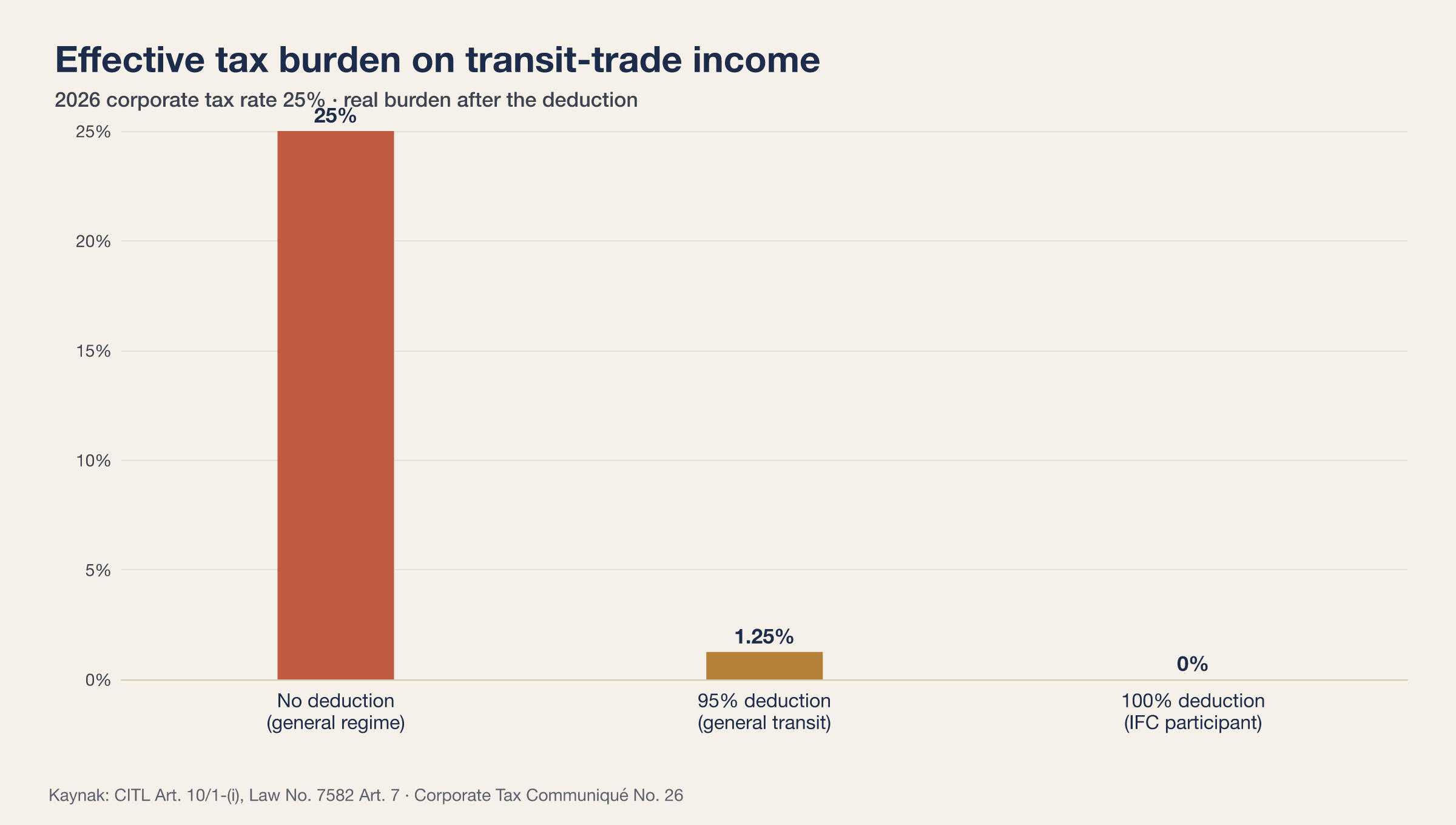
Is moving to the IFC worth it for 5 points? The math is simpler than it looks. In 2026 the corporate-tax rate is 25%; on income with a 95% deduction the taxable base left is 5% of the income, an effective burden of 1.25%. With 100% in the IFC, the burden is zero. The difference is 1.25% of the transit income:
- On annual transit income of TRY 100,000,000 (2026), the IFC advantage: TRY 1,250,000/year.
- Break-even formula: if the IFC’s total annual extra cost (participant certificate, office, relocation and compliance costs) is M, then for the IFC to pay off the annual transit income must exceed M × 80. For example, a structure with TRY 2,000,000 (2026) of annual extra cost only comes out net ahead in the IFC above TRY 160,000,000 of transit income.
Two notes: first, the IFC package’s return is not just these 5 points — the personal income-tax reduction for staff at participant entities and the incentive horizon extended to 2047 by Law 7582 Art. 13 are also on the table; we covered the whole IFC side in IFC 2026 New Regulations. Second, the President is empowered to reduce the Art. 10/1-(i) rates to zero and raise them to 100%; this decision matrix is not fixed, it is decision-sensitive.
Four traps: the scenarios that lose the deduction
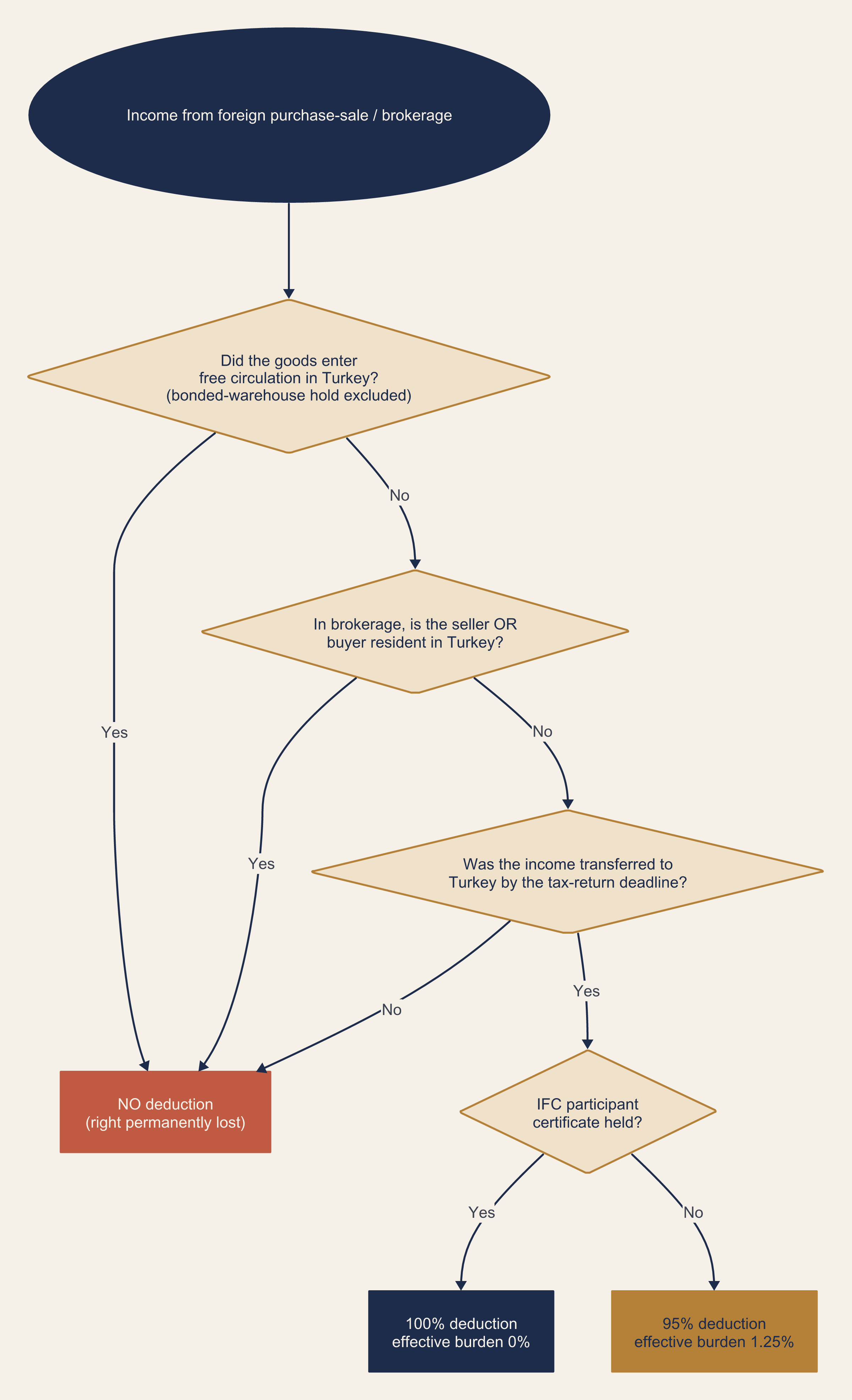
1 — Late transfer = permanent loss of the right. The Communiqué’s language is harsh: for any portion not transferred to Turkey by the end of the filing period the deduction is unavailable, and that portion cannot be deducted “even if transferred to Turkey in later years.” There is no cure mechanism, no correction return, no partial rescue. A single wire stuck in a foreign correspondent-banking chain permanently brings back the tax on 95% of the income. The transfer timetable must be built to close at least one month before the filing calendar.
2 — A Turkish party in intermediation. In intermediation income the seller and the buyer of the goods must not be in Turkey. If the buyer at the end of the chain is resident in Turkey — even if the goods never touch Turkey — that transaction’s commission is out of scope. In intra-group trade this condition is especially insidious: the intermediation commission on goods bought from a foreign affiliate and “delivered abroad” to a related company in Turkey does not carry the deduction.
3 — Goods “entering” Turkey — except the bonded warehouse. If the goods enter free circulation or undergo any processing in Turkey, the deduction falls away. By contrast, goods held in a bonded warehouse without nationalization and sold abroad remain in scope (Communiqué Example 4). The boundary is not physical geography but customs status. The operations team’s “let’s pull the goods to Istanbul” decision must not be taken without asking the tax team.
4 — Means-of-payment codes. Detailed below: in the sale of digital codes, the line between a product code and a means of payment determines the entire deduction.
The digital-product and game-code opportunity: the least-discussed part of the Communiqué
Communiqué No. 26 did not confine the transit-trade deduction to physical commodities. The Communiqué text explicitly states that the deduction applies to income from selling activation codes, e-pin codes, game codes, digital-product codes, licence codes, subscription codes and similar products — without changing their nature and content, without being subject to any disposition or use in Turkey — directly to persons or entities resident abroad.
On the other side of the line are cards, passwords, codes, balances, wallet codes and gift cards that qualify as a means of payment: income from trading these is out of scope.
This distinction is the heart of the regime for distributors and digital-product wholesalers who buy game keys/e-pins abroad and sell them to foreign markets:
- Selling a game code bought from a foreign publisher to a platform/end-user abroad → 95% of the income is deducted.
- The same company’s trade in gift cards / balance codes → no deduction; the income of the two product groups must be separated in the accounts.
- If the code is activated in Turkey, its content changed, or it is sold to a user in Turkey, the chain breaks.
The Communiqué goes one step further: the sale abroad of intangible rights such as copyrights, trademarks, patents, utility models, designs, licences and publishing rights — without modification and without being used in Turkey — is also in scope, provided that no right of disposition remains with the seller after the sale. In other words, it covers a transfer of the right, not a term licence.
We described the structuring side for foreign game groups setting up a studio in Turkey in The Journey of a Foreign Game Studio to Turkey; this subparagraph adds a new option to the distribution/publishing layer of that design.
32/C and Pillar Two: the deduction’s two invisible tests
Domestic minimum corporate tax (32/C) — test passed. CITC Art. 32/C says the base a company declares cannot be less than 10% of income before deductions and exemptions are added back; many incentives dissolve in this floor. Law 7582 Art. 9 solved this fate up front: the 10/1-(i) and (j) deductions were added to the items deducted when determining the minimum-corporate-tax base. Result: the transit-trade deduction does not catch on the 10% floor; at 95% the effective burden stays at 1.25%, and in the IFC at zero.
Global minimum tax (Pillar Two/QDMTT) — the test depends on the group. Law No. 7524 introduced Türkiye’s local and global minimum top-up tax rules for in-scope MNE groups. Low-taxed income in an IFC group entity using the 100% deduction may reduce Türkiye’s jurisdictional effective tax rate, but the QDMTT result depends on jurisdictional blending, covered/deferred taxes, GloBE adjustments, safe harbours, elections and SBIE. Do not assume the transit-trade entity’s payroll and tangible-asset profile; measure it from company data. For the full mechanism see The QSC and IFC Deduction Against Pillar Two.
The domestic and global layers are distinct. CITC Art.32/C lists the Art.10/1-(i) deduction among items deductible in the domestic minimum-tax base, while Pillar Two uses a separate computation. The 1.25%/0% arithmetic produced from the 95%/100% statutory deduction is not a promised final effective tax rate. For an in-scope group, the IFC advantage can be assessed only after the complete jurisdictional model.
10/1-(i) transit trade vs 10/1-(j) QSC: which subparagraph is yours?
Law 7582 placed two neighbouring subparagraphs in the same article, and they are often confused in the field:
T2 — subparagraph (i) vs subparagraph (j)
| Criterion | 10/1-(i) transit trade | 10/1-(j) qualified service center (QSC) |
|---|---|---|
| Subject | Trade in goods: sale without entering Turkey / intermediation of foreign purchase-sale | Services to foreign related companies (management, reporting, coordination, etc.) |
| Rate | 95% — IFC / suitable industrial zone 100% | 95% — IFC / suitable industrial zone 100% |
| Time limit | None | 20 fiscal years from the period of becoming operational |
| Status condition | None (participant certificate for IFC 100%) | Capital company + serving a group operating in ≥3 countries + ≥80% of revenue from foreign related companies |
| Transfer condition | Transfer to Turkey by the filing deadline | Transfer to Turkey by the filing deadline |
| Presidential rate power | Reduce to zero / raise to 100% | Reduce to 50% / raise to 100% |
| Minimum tax (32/C) | Deducted from the base | Deducted from the base |
The point to watch is the QSC’s 80% threshold: the figure of 75% circulating in some secondary sources is wrong; the wording of additional Art. 1 added to Law No. 4875 is 80%.
And a separate-regime warning: the financial-services-export deduction in IFC Law Art. 6 (75% statutory rate, 100% in practice under Provisional Art. 1, extended to 2047 by Law 7582 Art. 13) is a third mechanism independent of these two subparagraphs — the conditions, durations and calculations of all three differ.
If a group carries both goods and service flows, the right subparagraph selection and income separation are the first step of the structuring; we covered the payroll leg of the QSC in our QSC wage-exemption guide.
The foreign-investor perspective: what is left after the deduction?
Foreign groups weighing the regime to set up a trading hub in Turkey should read three layers separately:
- Dividend withholding. The deduction operates at the corporate-tax layer; when profit is distributed to the foreign shareholder a 15% withholding kicks in (Presidential Decision No. 9286, from 22.12.2024 — the 10% rate of 2021 is out of date). Double-tax treaties generally reduce this to the 5–15% band depending on the participation threshold. Compared with Dubai, Netherlands or Singapore hubs, Turkey’s structural cost is not in the corporate tax but in this distribution layer; net return must be modelled through the ownership chain and treaty network.
- VAT. In a transit delivery the goods are not nationalized in Turkey, so the place of delivery is not Turkey; the transaction falls outside the scope of VAT (VAT Law Arts. 1 and 6) — not an exemption, but out-of-scope status. By contrast, storage, transport, warehousing and logistics services procured in Turkey may be subject to VAT; because the transaction is outside the VAT scope, the fate (deduction/expense) of input VAT on these services must be planned up front in the accounting design.
- Substance and transfer pricing. Directing group profitability to a Turkish company with a 100% deduction requires a defensible function-risk-asset file, both for arm’s-length purposes in Turkey and for controlled-foreign-company (CFC) rules in the parent’s country. The regime is new, there is no case law; the contract architecture and local decision-making capacity must be demonstrable.
Advance (provisional) tax timing requires a cautious formulation: because Law 7582 Art. 14/b ties the measure to “returns due from 1.7.2026,” the deduction being applied for the first time in the 2026 2nd provisional-tax-period return (final day 17 August 2026) is what the letter of the Law requires, and the sector view is the same. However, as of 16 July 2026 no circular specific to the subject or announcement of the return software from the Revenue Administration could be identified — pre-filing Revenue Administration announcements must be confirmed.
Gökay GÜL’s Note: Plan the transfer condition around banking reality: “by the filing deadline” is the legal limit, not the operational one. Compliance reviews at foreign correspondent banks can hold a wire for weeks; I tell my clients to finish transit-income transfers in the first quarter following the close of the fiscal period and to leave not a single transfer to the filing month. Second: for those trading in digital codes, tag the product catalogue with tax eyes — which SKU is a “digital product code,” which is a “means of payment”; this distinction must be recorded in the invoicing and the subsidiary ledgers. If the answer to “how much of the income is deductible” cannot be pulled from the system in an audit, the deduction stays on paper.
A case from the field: two code groups, one set of books, a lost deduction
Note — representative example: The case below is a composite distilled from situations frequently encountered in advisory practice; it does not describe a single real taxpayer one-to-one. The figures are typical magnitudes to show the mechanics.
A Scandinavian-origin digital-distribution group was, at the start of 2026, running two business lines together through its company in Turkey: (a) selling game keys and e-pin codes bought from foreign publishers to platforms in Europe and the Middle East, and (b) supplying prepaid wallet-balance and gift-card codes to the same platforms. Both flows worked on the “buy abroad, sell abroad, goods never enter Turkey” logic; the company planned to apply the transit-trade deduction on the total digital turnover.
When we put Communiqué 26’s distinction on the table, the picture changed. The game-key and e-pin side — roughly TRY 40,000,000 (2026) of income a year — qualified fully for the deduction as a “digital product code.” But the wallet-balance and gift-card side — roughly TRY 25,000,000 of income — was out of scope because it is a means of payment.
Because the company’s books pooled the two flows in a single revenue account, the audit question “how much of the income is deductible” could not be answered from the system; as it stood, all of the deduction was at risk.
We made two interventions: (1) we tagged the product catalogue at SKU level as “digital product code” and “means of payment” and separated the subsidiary ledgers; (2) we brought forward the transfer timetable for foreign collections to Turkey, counting back from the filing month to remove correspondent-bank compliance times.
Result: the deductible income could be reported cleanly at TRY 40,000,000 net — with the 95% deduction, the effective burden on this portion fell to 1.25%, and an annual base difference of roughly TRY 9.5 million (2026) became defensible on a documented basis. The out-of-scope TRY 25,000,000, tracked as non-deductible from the outset, removed the penalty + late-interest risk of treating the whole as deductible.
The lesson in one sentence: in this regime the real loss hides not in the wrong rate, but in unseparated income.
Action list: how to set up the regime in 6 steps
- Income map (now): Separate the transit-qualifying transactions from 1.1.2026 to today — direct sale, intermediation, digital code, intangible right; make the deductible income reportable by transaction type.
- Transfer timetable: Build an internal process that completes the transfer of transit income in foreign accounts to Turkey at least one month before the filing calendar; plan bank compliance times into the buffer.
- Intermediation-chain check: Run the residence test on the seller and buyer at the contract stage for intermediation transactions; track the income of transactions involving a Turkey-resident party as non-deductible.
- Warehouse/customs status: Where the goods physically touch Turkey, bind the ban on entering free circulation and on processing into a written procedure with the logistics team.
- IFC feasibility: Compute the IFC advantage with the annual transit income × 1.25% formula; compare against the participant-certificate and relocation cost. For groups above EUR 750m, add QDMTT modelling to the decision; put the industrial-zone Presidential Decision on watch.
- Provisional tax preparation: Before the 2026 2nd-period provisional-tax return (final day 17 August 2026), confirm the Revenue Administration’s announcements and the return software; check that the deduction line carries correctly onto the return.
Sources
- Law No. 7582 Amending Certain Laws (Official Gazette 04.06.2026/33270) — Arts. 7, 9, 13, 14
- Corporate Tax General Communiqué No. 26 (Official Gazette 04.07.2026/33300) — Communiqué section 10.7
- CITC No. 5520 Arts. 10/1-(i), 10/1-(j), 32/C; IFC Law No. 7412 Art. 6 and Provisional Art. 1
- Law No. 7524 (Official Gazette 02.08.2024/32620) — local and global minimum top-up corporate tax
- Presidential Decision No. 9286 (Official Gazette 22.12.2024) — dividend withholding
- VAT Law No. 3065 Arts. 1, 6
- PwC, KPMG, Deloitte bulletins on Law 7582 and Communiqué 26; Sistem Global tax bulletin — post-communiqué secondary analyses
Frequently asked.
When did the transit-trade income deduction start, and for which income?
Law No. 7582 was published on 4 June 2026; the measure entered into force to apply from returns due from 1.7.2026 and to income of taxation periods beginning from 1.1.2026. So all of 2026's transit income — including the months before the Law's publication — is in scope.
Who does the 100% deduction apply to today?
Only to entities operating in the IFC with a participant certificate under Law No. 7412. The Law also grants 100% to industrial zones; but because no Presidential Decision on which zones are deemed suitable had been located as of 16 July 2026, that channel is not yet effectively open.
What happens if the income is not transferred to Turkey in time?
For any portion not transferred by the end of the filing period the deduction does not apply, and under the Communiqué that portion cannot benefit from the deduction even if transferred in later years. The loss of the right is permanent; if partially transferred, the deduction applies only to the transferred portion.
Does the deduction fall away if the goods come into a bonded warehouse?
No — if the goods are sold abroad from the warehouse without entering free circulation and without any processing, the deduction applies (Communiqué Example 4). If the goods enter free circulation in Turkey or are sold to a buyer in Turkey, the deduction is lost.
Are game-code and e-pin sales in scope?
Yes — income from selling activation, e-pin, game, digital-product, licence and subscription codes directly to foreign residents, without changing their content and without being subject to use in Turkey, benefits from the deduction. Trade in balances, wallet codes and gift cards that qualify as a means of payment is out of scope.
Does the deduction catch on the minimum corporate tax?
It does not catch on the domestic minimum corporate tax (10%): Law 7582 Art. 9 added the 10/1-(i) deduction to the items deducted from the minimum-tax base. However, in multinational groups whose annual consolidated revenue exceeds EUR 750 million the global minimum tax (QDMTT) can create a top-up; above-threshold groups should run top-up modelling.
Clarify the Türkiye structure
Let’s model the tax benefit together with real activity and substance.
Share the group structure, planned activity in Türkiye and revenue flow. We will separate the eligibility conditions and operating burden of the relevant route.
Review the international advisory scope →Do not send passwords, OTP codes, passport details, tax numbers, contracts or confidential group documents in your first message.