
Blog
The Freelance Coder's 'FX Trap': You Can Deduct 100% of Foreign Software Earnings — But Bring the Money Late and It Drops to Zero (2026)
A freelancer writing code for a foreign client can deduct 100% of that income from the income-tax base under Income Tax Law Art. 89/1-(13). But this is not an exemption — it is a conditional deduction: unless the ENTIRE earnings are transferred to Turkey by the annual return's filing date, the deduction is lost not partially but entirely. On top of that the regimes get mixed up (the 89/13 deduction requires timely transfer of the earnings, the VAT exemption requires currency only for the refund, and provisional tax is a periodic prepayment), and the entity choice — self-employed, commercial, or a limited company — changes the math: in a limited company even a 100% deduction does not zero out the domestic minimum corporate tax unless the start-up exemption applies.

In this article
Regulatory note: As of 2026-07-26, this article is based on Article 89/1-(13) of Income Tax Law No. 193 (the deduction for software and similar services rendered abroad) and its Repeated Article 120 (provisional tax), Presidential Decision No. 11257 raising the rate to 100% (30.04.2026, Official Gazette No. 33239), Articles 10/1-ğ and 32/C (domestic minimum corporate tax) of Corporate Income Tax Law No. 5520, Article 11/1-a of Value Added Tax Law No. 3065, Law No. 7566 reinstating the 4th provisional-tax period (Official Gazette 19.12.2025), VAT General Communiqué Serial No. 509, and Revenue Administration rulings on point. A freelancer’s concrete situation (the nature of the activity, the entity, the income breakdown) changes the outcome; for a critical transaction, consult your own accountant.
You are writing code for a customer abroad. The money lands in your Payoneer, your Wise, or your bank account as foreign currency. And you heard good news: you can deduct 100% of the earnings from software services rendered abroad from your tax base. It sounds like “tax-free income.”
But this is where the trap that costs the most in the field is hiding. Because this is not an exemption — it is a conditional deduction. And if you miss the condition, the deduction does not shrink a little; it disappears entirely.
The 60-Second Answer
ITL Art. 89/1-(13) allows the earnings from software (and engineering, design, data processing, and similar) services rendered to persons abroad and used exclusively abroad to be deducted from the tax base. The rate was raised from 80% to 100% by Presidential Decision No. 11257 (for periods starting on or after 1/1/2026).
Know three things from the outset:
- A deduction is not an exemption. It works on net earnings: if the activity closes at a loss there is nothing to deduct, and any portion you cannot use does not carry over to next year.
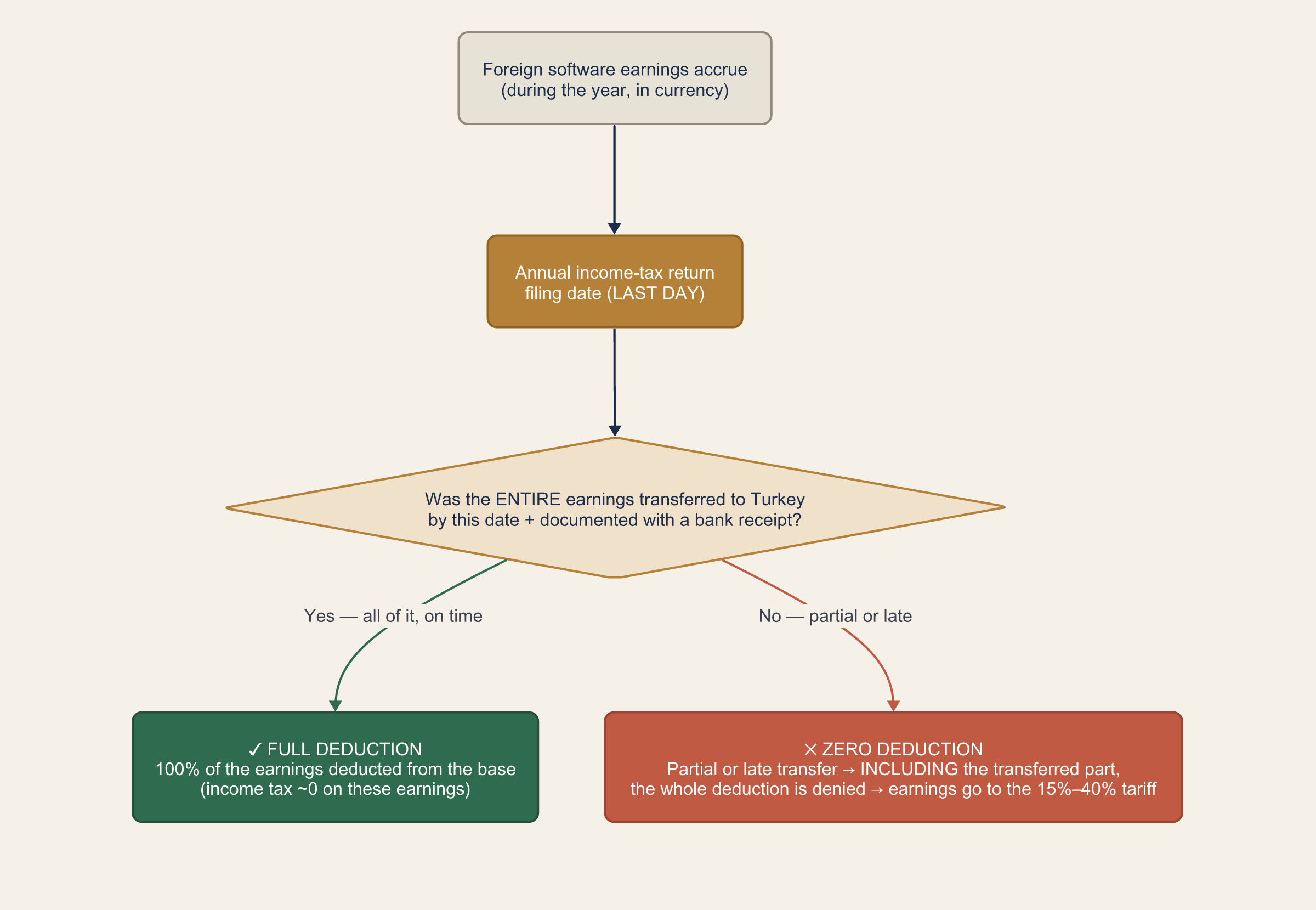
- The FX trap. To use the deduction you must transfer the entire earnings to Turkey by the date the annual income-tax return is due. If you bring only a part instead of all of it, you lose the whole deduction — including the part you did bring.
- Two separate transfer rules, plus provisional-tax timing. On the same income: (1) the ITL 89/13 earnings deduction requires the earnings subject to it to be transferred to Turkey on time; (2) in the VAT service-export exemption the currency is needed only for the refund of input VAT (not for the exemption itself); (3) provisional tax has no separate currency rule but is prepaid in three-month periods as earnings accrue. All three get confused with one another.
Then there is the entity choice: are you a self-employed professional, a sole proprietor, or a limited company? This changes which article you rely on, your provisional tax, your Bağ-Kur (social security), and the real return on the deduction.
What Is the ITL 89/1-13 Earnings Deduction?
The law ties the deduction to services listed in the statute: architecture, engineering, design, software, medical reporting, bookkeeping, call centres, data storage/processing/analysis, and so on. Because software is listed, a software-development service rendered directly to a customer abroad can — together with the other conditions — fall within scope. But the word “software” does not sweep every software-related income into scope automatically: off-the-shelf software sales, a licence or copyright transfer, a SaaS subscription, or platform / in-app sales income are characterised separately and may fall outside the service deduction. An important point: the deduction is open not only to companies but also to self-employed professionals and individuals with commercial income.
The conditions are set out one by one in a ruling the Revenue Administration gave to a freelance software engineer (18008620-120[2023-720-39]-119534, 11.06.2025):
- The service must be rendered to persons not resident in Turkey (whose workplace, legal seat, and place of management are abroad).
- The benefit must be used exclusively abroad.
- The invoice or self-employment receipt must be issued in the name of the customer abroad.
- And the real knot: the entire earnings must be transferred to Turkey by the date the return for the year in which they were earned is due. (For an individual, the annual income-tax return; for a company, the corporate-tax return for the relevant accounting period.)
A subtlety: “the entire earnings” here is not the gross currency that lands in your account but the net earnings subject to the deduction — the amount that remains after payment-processor fees, expenses, and exchange differences are removed and the eligible activity earnings are separated out. If you work a mix of domestic and foreign, only the earnings of the eligible (exclusively-abroad) activity are subject to the deduction; that has to be computed separately.
This last condition is the “FX trap” itself. The same ruling says it plainly: if part rather than all of the earnings is transferred, the deduction cannot be used including the transferred part; and earnings not brought in within the period cannot benefit even if brought in later. So the deduction is all-or-nothing.
Why so strict? Because the deduction is a different mechanism from an exemption. An exemption puts the income outside tax from the start; a deduction is a line subtracted from the base on the return. That is why there is no deduction against a loss, no carry-over, and the whole right falls away when one condition is missed.
Don’t let FX freedom mislead you. As a service exporter, under the Export Circular you are not required to bring the currency into Turkey and tie it to a currency-purchase document (DAB) — the repatriation requirement that applies to goods exports does not apply to service exports. But this FX freedom does not remove the transfer condition in ITL 89/13. The same Revenue ruling says it clearly: even if bringing the currency is free from an FX-control standpoint, if you want the deduction you must document that the earnings were transferred to Turkey. In short: the price of the tax benefit is giving up the freedom to keep the money offshore.
A Numeric Comparison: Same Earnings, Different Entity and FX Decision
Let’s put a freelancer with 1,000,000 TL (foreign-currency equivalent) of net annual foreign software earnings side by side in four scenarios. The figures are illustrative; the point is to show the mechanism.
| Scenario | Income/corporate-tax logic | Result |
|---|---|---|
| Self-employed / sole proprietor + 100% deduction (currency arrived on time) | 100% of the earnings is deducted from the base under ITL 89/13 | Income tax on these earnings is ~0; Bağ-Kur and VAT are separate matters |
| Limited company + 100% deduction (currency arrived on time) | 100% of the corporate earnings is deducted under CITL 10/1-ğ but the CITL 32/C domestic minimum corporate tax may come into play | Unless the start-up exemption (first 3 accounting periods) applies, a 10% minimum corporate tax may arise on the CITL 32/C base — a 100% deduction alone does not deliver zero tax |
| Self-employed + LOSS of the deduction (currency arrived after the filing date) | Transfer condition breached → the deduction falls away entirely, all earnings go to the progressive tariff | The whole 1,000,000 TL is taxed at the 15%–40% tariff |
| Mistaking it for ITL rep. 20/B | A freelance B2B software service is not within rep. Art. 20/B | Exemption denied + back tax + penalty risk |
The table has three lessons. First, an individual and a limited company may not land in the same place even with the same 100% deduction: in a limited company, if the start-up exemption does not apply, the minimum-corporate-tax floor can block reaching zero. Second, the cost of falling into the FX trap is as large as the deduction’s value — you go from near-zero tax to all earnings entering the tariff. Third, leaning on the wrong regime (rep. 20/B) is a flawed footing from the start.
Don’t confuse the VAT exemption with the CIT rules. A freelancer selling software abroad has three separate items that get tangled together. The income/corporate-tax deduction (ITL 89/13 or CITL 10/1-ğ): timely transfer of the entire earnings is required. The VAT service-export exemption (VAT Law Art. 11/1-a): a service used abroad for a customer abroad is VAT-free; you do not need currency to arrive in order to issue the VAT-free invoice — the currency is needed only for the refund of the input VAT you incurred. The domestic minimum corporate tax (CITL 32/C): it concerns only companies (limited/joint-stock); because the 10/1-ğ deduction is not subtracted from the base of this minimum tax, even a 100% deduction may not, on its own, bring the company down to zero tax. There is a start-up exemption for the first three accounting periods of newly established companies; if that exemption does not apply, the minimum corporate tax arises. An individual has no such minimum-tax floor — which, on pure export income, can often make the self-employed structure advantageous. (The final decision must be modelled together with dividend withholding, social-security status, the expense structure, and the growth plan.)
Decision Matrix: Entity, FX Calendar, and Traps
| Question | What you do / what happens |
|---|---|
| Self-employed, sole proprietor, or limited company? | Pure foreign software income + low expenses → an individual (self-employed) is often advantageous (no minimum corporate tax). Scale/partnership/corporate clients → a limited company; but factor the minimum corporate tax in. |
| The FX-trap calendar | Bring the entire earnings to Turkey by the end of the income-tax return’s filing period and document it with a bank receipt. Partial/late transfer = the whole deduction is gone. |
| Does ITL rep. 20/B apply to me? | For most freelance developers, no. Rep. Art. 20/B is specific to “social-content creation” and “developing a mobile app and publishing it on a platform (App Store/Google Play).” A B2B software service rendered to a customer abroad under a bespoke contract is not within that scope → ITL 89/13. |
| How many provisional-tax periods? | In 2026, 4 periods. The 4th provisional-tax period was reinstated by Law No. 7566 (Official Gazette 19.12.2025); for an individual the rate is 15% (ITL Repeated Art. 120), offset on the annual return. |
| Am I working through an app store / reseller? | Then “exclusively abroad” and “who is the exporter” work differently; this article addresses the freelancer serving the customer directly (B2B). |
Gökay GÜL’s Note
Gökay GÜL’s note: When I sit down with a developer working for clients abroad, the first thing we build is a transfer calendar. Because the most expensive breach of the deduction is leaving the money in the account (Payoneer, Wise, an offshore bank) and saying at year-end, “I’ll bring it in somehow.” The rule is clear: the earnings subject to the deduction must have arrived in Turkey by the last day of the filing period and be documented with the transfer chain — above all a bank receipt (plus the contract, account statement, payment-institution report, and receipt/invoice matching). If it arrives late or short, that year’s deduction burns. I track three things: (1) the currency inflows during the year and which earnings they belong to, (2) the balance that must be brought in by the filing date, and (3) the receipt for each transfer. And the entity: in a one-person business with pure export income, self-employment is often better than a limited company, because in a limited company even a 100% deduction does not zero out the minimum corporate tax. Don’t confuse FX freedom with the tax condition either — you can keep the money offshore, but then you give up the deduction.
Field Case
(Illustrative example — an anonymous composite distilled from real taxpayer experiences.)
A developer working as a self-employed professional in İzmir provided remote development services to two customers abroad. The earnings were good; the payments came in foreign currency through a payment intermediary. On the accounting side it was understood as “foreign software, there’s a 100% deduction,” and the return was built on that. In the first year the deduction was applied without issue.
The problem surfaced in the second year. The developer had kept part of the currency in an offshore account and brought only what was needed to Turkey — and had transferred the remainder after the filing date, at that. The audit established that the entire earnings had not been transferred in time. The result was not a “partial deduction”: because the transfer condition was breached, the whole of that year’s deduction was denied. The earnings, expected to be taxed at near zero, were taxed entirely at the progressive tariff; late-payment interest and a penalty were added on top.
In a picture like this, what you can do is not to erase the past but to rebuild the discipline. For later periods a transfer calendar is set up: each earning is brought to Turkey before the filing period of its year and documented; the choice to leave money offshore is made in the full knowledge that this part means giving up the deduction. What really changes is this: the comfort of “there’s a 100% deduction, I’m fine” turns into the discipline that “the most easily breached condition of the deduction is bringing the money in on time.”
Frequently Asked Questions
Should I register as self-employed or set up a company? In a one-person business with pure foreign software income and low expenses, an individual (self-employed or commercial income) can be advantageous in most cases: you use the ITL 89/13 deduction, and an individual has no floor like the domestic minimum corporate tax. A limited company / joint-stock company makes sense when scale, partnership, corporate clients, or limited liability are required; but even if you apply the CITL 10/1-ğ 100% deduction, (unless the start-up exemption applies) zero tax may not result because of the CITL 32/C minimum corporate tax. The decision is made by modelling the total tax burden, dividend withholding, social-security status, and the growth plan together — not by looking at the minimum tax alone.
Is the 100% deduction applied automatically? No. The earnings must arise from a service listed in the statute (software), be used exclusively abroad, the invoice/receipt must be issued in the name of the customer abroad, and — most critically — the entire earnings must be transferred to Turkey by the filing date. The deduction is computed on net earnings; there is no deduction against a loss, and any unused portion does not carry over.
What happens if I don’t bring the currency to Turkey? The deduction disappears entirely. Even though FX-control rules do not require repatriating service-export currency, transfer is a separate condition for the ITL 89/13 deduction. If the entire earnings do not arrive in time — whether part arrives or all of it arrives late — the whole of that year’s deduction is denied and the earnings are taxed under the ordinary tariff. That is why “I’ll bring the money in later” is the most expensive sentence.
Is there also a VAT exemption? Yes, but it is a separate regime. Software used abroad for a customer abroad is exempt from VAT under VAT Law Art. 11/1-a; you issue the self-employment receipt/invoice VAT-free. The currency rule here is different: you do not need currency to arrive in order to issue the VAT-free invoice; currency is needed only if you want to claim the refund of the input VAT you incurred for this work. So the income-tax deduction and the VAT exemption are two separate doors, with two separate currency logics.
Does ITL Repeated 20/B (the social-content / mobile-app exemption) apply to me? For a B2B software service rendered directly to a customer, most likely no — and this is a frequently confused trap. Repeated Art. 20/B is specific to income from “social-content creation” and from “developing an app for mobile devices and publishing it on platforms such as the App Store / Google Play”; for those there is an exemption up to a certain revenue threshold and final withholding through the bank. Software/coding/consulting rendered to a customer abroad under a bespoke contract is not within that scope; that income is assessed under the ITL 89/13 service-export deduction. But if you publish your app on a platform and earn income from it, rep. 20/B must be examined separately, with its revenue threshold and bank/withholding conditions. (Note: rep. 20/B is different from the young-entrepreneur earnings exemption — ITL Repeated Art. 20 — don’t confuse the two. Also verify separately the change under which the Bağ-Kur premium support for young entrepreneurs was removed in 2026.)
What You Should Do
- Set up a transfer calendar. Bring each foreign earning to Turkey by the end of the filing period of the income-tax return for its year and document it with a bank receipt. Partial or late transfer burns the whole deduction.
- Choose the entity deliberately. On pure export income with low expenses, self-employment is often advantageous; if you will choose a limited company / joint-stock company, factor the CITL 32/C minimum corporate tax in from the outset. A 100% deduction does not mean zero tax in a limited company.
- Manage the deduction, the VAT exemption, and provisional tax separately. The three work on separate currency/time rules: the deduction requires full transfer, in the VAT exemption currency is only for the refund, and provisional tax in 2026 is 4 periods (Law No. 7566 brought the 4th period back; for an individual, 15%).
- Don’t fall into the rep. 20/B trap. A bespoke software service for a customer abroad falls under ITL 89/13, not rep. 20/B. Don’t confuse it with app-publishing / social-content income; when in doubt, request a ruling.
- Set up e-self-employment receipts and social security. If your activity is self-employment income, move to the e-Self-Employment Receipt under VAT General Communiqué Serial No. 509 (by the end of the third month following the start of activity); if it is commercial income, to e-Invoice. Issue the document to the customer abroad VAT-free. When the tax registration opens, Bağ-Kur coverage (Law No. 5510 Art. 4/1-b) comes into play; but if you already have 4/a (employee) coverage, the overlap must be checked separately under Law No. 5510 Art. 53/1. Deduct the Bağ-Kur premium you pay in line with the payment condition and the relevant provision — and be careful not to deduct the same amount twice. At Sistem Global Danışmanlık, our approach is always to build the deduction together with the transfer documentation.
Sources: Income Tax Law No. 193 Art. 89/1-(13) and Repeated Art. 120; Presidential Decision No. 11257 (30.04.2026, Official Gazette No. 33239); Corporate Income Tax Law No. 5520 Art. 10/1-ğ and Art. 32/C; VAT Law No. 3065 Art. 11/1-a; Law No. 7566 (Official Gazette 19.12.2025 — 4th provisional-tax period); Income Tax Law No. 193 Repeated Art. 20/B; VAT General Communiqué Serial No. 509; Revenue Administration ruling E-18008620-120[2023-720-39]-119534 (11.06.2025). This article is for general information; before a concrete transaction, consult your own accountant for your specific situation.
Frequently asked.
Should I register as self-employed or set up a company?
In a one-person business with pure foreign software income and low expenses, an individual (self-employed or commercial income) can be advantageous in most cases: you use the ITL 89/13 deduction, and an individual has no floor like the domestic minimum corporate tax. A limited company / joint-stock company makes sense when scale, partnership, corporate clients, or limited liability are required; but even if you apply the CITL 10/1-ğ 100% deduction, (unless the start-up exemption applies) zero tax may not result because of the CITL 32/C minimum corporate tax. The decision is made by modelling the total tax burden, dividend withholding, social-security status, and the growth plan together — not by looking at the minimum tax alone.
Is the 100% deduction applied automatically?
No. The earnings must arise from a service listed in the statute (software), be used exclusively abroad, the invoice/receipt must be issued in the name of the customer abroad, and — most critically — the entire earnings must be transferred to Turkey by the filing date. The deduction is computed on net earnings; there is no deduction against a loss, and any unused portion does not carry over.
What happens if I don't bring the currency to Turkey?
The deduction disappears entirely. Even though FX-control rules do not require repatriating service-export currency, transfer is a separate condition for the ITL 89/13 deduction. If the entire earnings do not arrive in time — whether part arrives or all of it arrives late — the whole of that year's deduction is denied and the earnings are taxed under the ordinary tariff. That is why 'I'll bring the money in later' is the most expensive sentence.
Is there also a VAT exemption?
Yes, but it is a separate regime. Software used abroad for a customer abroad is exempt from VAT under VAT Law Art. 11/1-a; you issue the self-employment receipt/invoice VAT-free. The currency rule here is different: you do not need currency to arrive in order to issue the VAT-free invoice; currency is needed only if you want to claim the refund of the input VAT you incurred for this work. So the income-tax deduction and the VAT exemption are two separate doors, with two separate currency logics.
Does ITL Repeated 20/B (the social-content / mobile-app exemption) apply to me?
For a B2B software service rendered directly to a customer, most likely no — and this is a frequently confused trap. Repeated Art. 20/B is specific to income from 'social-content creation' and from 'developing an app for mobile devices and publishing it on platforms such as the App Store / Google Play'; for those there is an exemption up to a certain revenue threshold and final withholding through the bank. Software/coding/consulting rendered to a customer abroad under a bespoke contract is not within that scope; that income is assessed under the ITL 89/13 service-export deduction. But if you publish your app on a platform and earn income from it, rep. 20/B must be examined separately, with its revenue threshold and bank/withholding conditions. (Note: rep. 20/B is different from the young-entrepreneur earnings exemption — ITL Repeated Art. 20 — don't confuse the two. Also verify separately the change under which the Bağ-Kur premium support for young entrepreneurs was removed in 2026.)