
Blog
Invoicing Abroad Is Not Enough: In SaaS, 'Where the Benefit Is Used' Decides the VAT Exemption (2026)
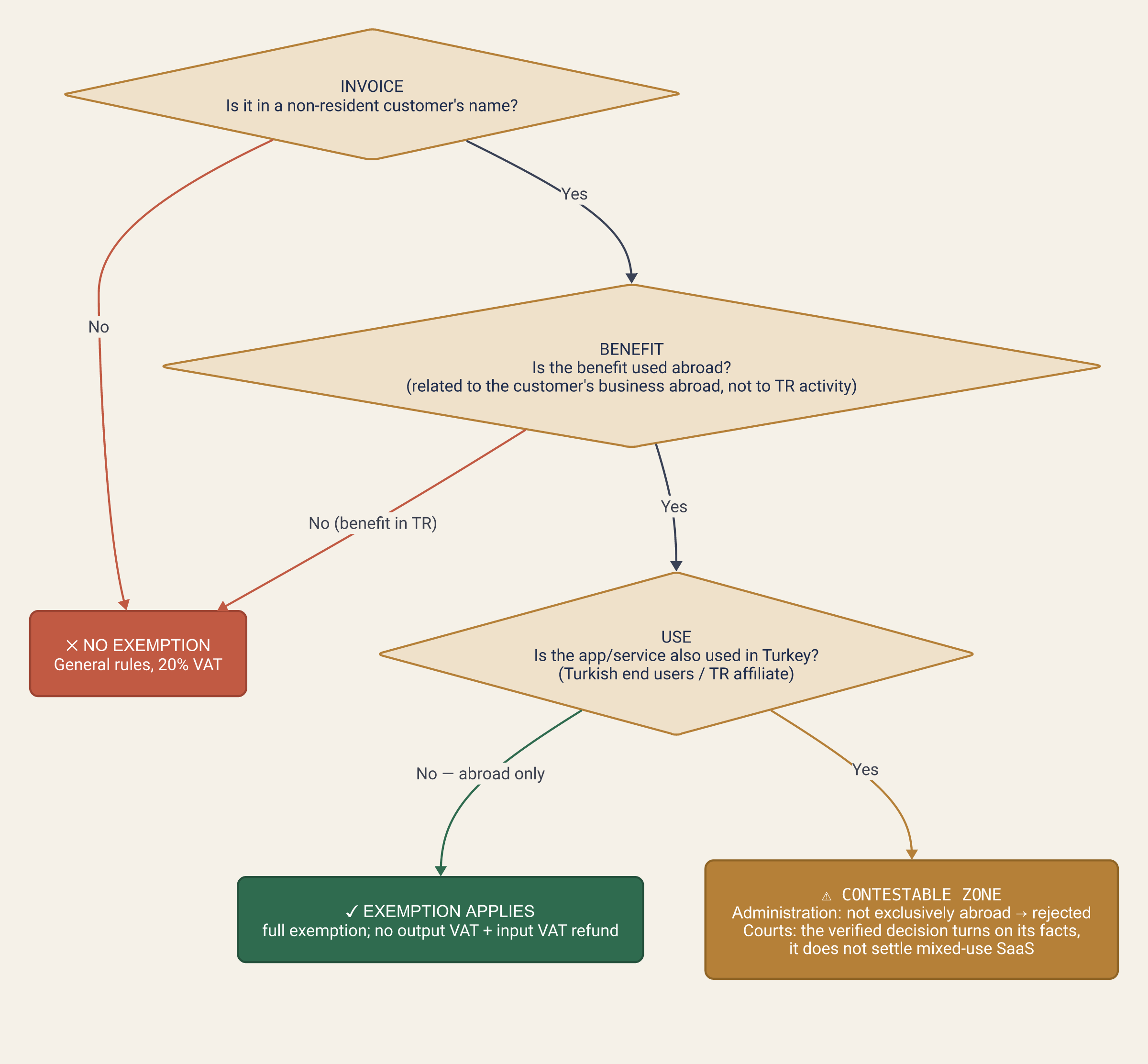
Selling SaaS or software to a foreign customer and issuing a VAT-free invoice does not, by itself, mean the service-export exemption applies. Turkey's VAT service-export exemption requires two conditions together: the service must be performed FOR a customer abroad AND the benefit must be USED abroad. The second condition is the real test: if the benefit is tied to an activity in Turkey, 20% VAT may arise. The administration reads mixed use strictly, while the judiciary examines the actual service recipient and place of benefit on the specific facts. Two further traps: bringing the service fee to Turkey is a condition for the REFUND, not for the exemption; and this VAT exemption is separate from the CIT Art. 10/1-(ğ) earnings deduction.

In this article
Regulatory review date: 11 September 2026. This article is based on VAT Law No. 3065 Arts. 6/b, 11/1-a, 12/2 and 32; section II/A of the VAT General Implementation Communiqué; CTC Art. 10/1-ğ; Presidential Decision No. 11257; Corporate Tax General Communiqué No. 26; the cited Revenue Administration rulings; and Council of State, 3rd Chamber E.2023/739 K.2025/4585. Benefit used abroad turns on the specific contract and usage model; for critical mixed-use transactions a taxpayer-specific ruling should be considered.
You sold a SaaS subscription or a bespoke software service to a company abroad. You issued the invoice in the foreign customer’s name, VAT-free. The reflex is simple: “This is an export, no VAT.” This is exactly where the most common mistake I see in the field begins.
Because invoicing abroad is not the single condition of the VAT exemption — it is only one piece of evidence. The question that actually opens or closes the exemption is different: where is this service’s benefit used? If the answer points to Turkey, the exemption closes even if the invoice went abroad and the currency came in.
The 60-Second Answer
Article 11/1-a of VAT Law No. 3065 exempts services performed for customers abroad. But Article 12/2 ties that exemption to two conditions together:
- The service must be performed for a customer abroad. This is evidenced by an invoice and similar documents issued in the name of the non-resident customer — but keep in mind that the invoice alone is not enough; the genuine customer relationship must also match the contract and the workflow.
- The benefit must be used abroad. That is, the service must relate to the customer’s business abroad and have no connection to an activity in Turkey.
Meeting the first condition is easy — you issue the invoice to the foreign company. The knot is in the second. In SaaS, even if the customer appears to be abroad, if the benefit is in fact used in Turkey, the exemption falls away and 20% VAT arises.
Two more frequently confused points:
- The payment question. Bringing the service fee to Turkey is not a condition of the exemption; if the two conditions are met you issue the VAT-free invoice and declare it. The payment’s arrival in Turkey comes into play when you want the refund of input VAT.
- VAT ≠ earnings deduction. The VAT exemption here (Art. 11/1-a) is a separate regime from the software-earnings deduction in CIT Art. 10/1-(ğ). The deduction requires the entire earnings to be transferred to Turkey; the VAT exemption has no such condition.
What Is the Service-Export Exemption?
VAT Law Art. 11/1-a brings “services performed for customers abroad” within the exemption. Art. 12/2 draws its frame: for a service to count as a “service export,” it must be performed for a customer abroad and the benefit must be used abroad. The two conditions are sought together; if one is missing, there is no exemption.
Why does the law weigh “benefit” so heavily? Because under Art. 6/b, a service being performed in Turkey or its benefit being used in Turkey makes the transaction one performed in Turkey — and therefore within the scope of Turkish VAT. A SaaS service produced in Turkey often continues to count as “performed in Turkey”; VAT is not charged not because the transaction leaves the scope, but because, once the two conditions are met, the Art. 11/1-a service-export exemption steps in. The benefit is the hinge that opens and closes this exemption.
Section II/A of the VAT General Implementation Communiqué, devoted to service exports, gives “benefit” concrete content: the benefit being used abroad means the service relates to the customer’s business, transactions and activities abroad, and has no connection to activities in Turkey. The same section gives a key example: intermediation, customer-finding or market-research services rendered in Turkey to a foreign firm for goods and services it will send to Turkey are outside the exemption — because that benefit is used in Turkey. The Communiqué adds plainly: the invoice being in the foreign firm’s name and the payment having been brought to Turkey do not change this outcome.
That is why “I invoiced abroad” is not, by itself, a defense. The conclusion of a Revenue Administration ruling on software and design services (76464994-130-211600, 30.07.2024) runs along the same line: a software/design service may be treated as a service export and exempt from VAT provided it is performed for a customer abroad and its benefit is used abroad. The condition has two legs in a single sentence.
One more critical distinction: the service-export exemption is a full exemption (Art. 32). You perform the transaction VAT-free and you may deduct the VAT you incurred on inputs for it — servers, software licenses, outside services — and claim a refund for the part you cannot recover through deduction. This is what separates service export from a partial exemption, where the sale is VAT-free but the input VAT is lost.
Do not confuse the VAT exemption with the earnings deduction. A company selling software abroad faces two separate regimes that are often mixed up. VAT exemption (Art. 11/1-a): no output VAT is calculated under the full exemption and input VAT may be refundable; the service fee need not reach Turkey to issue the VAT-free invoice. CIT Art. 10/1-(ğ) earnings deduction: it deducts from the tax base the earnings from software (and engineering, design, data processing and similar) services rendered abroad; its rate was raised from 80% to 100% by Presidential Decision No. 11257 (30.04.2026, Official Gazette No. 33239) for periods beginning on or after 1/1/2026. But its condition is strict: the entire earnings must be transferred to Turkey by the corporate tax return’s filing date. One is a full exemption on turnover (the invoice), the other a base deduction on net earnings; one does not require the service fee to arrive for the exemption, the other requires the transfer of all qualifying earnings. One more caveat: CIT Art. 10/1-(ğ) does not automatically cover every software/SaaS revenue — whether the transaction is one of the services listed in the provision or a royalty/license fee must be determined separately; if the nature differs, this deduction may not apply. The deduction also cannot be removed from the domestic minimum corporate tax base, so a 100% ordinary-base deduction does not always mean zero tax payable. Two regimes, two different outcomes.
The Numbers: Exemption vs. No Exemption
Let us put the VAT burden of the same sale in two scenarios side by side. Assume a SaaS studio issues 100,000 units of service fee per month (in TRY or foreign-currency equivalent) and incurs 18,000 units of input VAT that month to produce the service (servers, licenses, external inputs).
| Item | Exemption APPLIES (benefit used abroad) | NO exemption (benefit used in Turkey) |
|---|---|---|
| Output VAT (on sale) | 0 (full exemption; no output VAT calculated) | 20,000 (20%) |
| Input VAT incurred | 18,000 | 18,000 |
| Filing result | Refund right for input VAT tied to the exempt transaction that cannot be offset against other transactions’ VAT | 20,000 collected and declared; 18,000 deducted, 2,000 payable |
| Passed to customer | Invoice VAT-free | Invoice + 20% VAT (collected from customer or absorbed into cost) |
| Cash effect | Input VAT that cannot be recovered by deduction may be refunded (cash-positive) | If VAT cannot be collected from the customer, a direct cost |
(The table assumes 100,000 is the net service fee, excluding VAT.)
This table carries two lessons. First, the exemption does not merely mean “no VAT on the sale”; it means the input VAT tied to the transaction, where it cannot be recovered by deduction, may become refundable — a recurring cash item for a software firm selling abroad (subject to refund, documentation and input-attribution rules). Second, if you apply the exemption by mistake and later lose it (the benefit turns out to be in Turkey), the retroactive VAT usually comes straight out of your own pocket because it can no longer be collected from the customer; late-payment interest and penalties are added on top. Whether the VAT is added on top of the price (VAT-excluded) or computed within it (VAT-included) at assessment depends on the contract and pricing. The value of the exemption is matched by the cost of getting it wrong.
Decision Matrix: In Which Scenario Does “Benefit Used Abroad” Fall Away?
Read each row through a single question: “Who uses this service’s benefit, and where?” The following scenarios make the exemption contestable or invalid even if your invoice went abroad.
| Scenario | Where is the benefit used? | Exemption status |
|---|---|---|
| SaaS to a non-resident company, for its business abroad | Abroad | Solid (both conditions met) |
| Service for the foreign customer’s Turkish affiliate/branch | Turkey | Closes — 20% VAT even if currency arrives |
| Finding/marketing customers in the Turkish market for a foreign firm | Turkey | Closes (exact Communiqué example) |
| App/SaaS open to both abroad and the domestic market, Turkish users too | Partly Turkey | Contestable — administration and courts diverge (below) |
| Sale via app store / reseller, counterparty a foreign platform | Depends on the contract | If the platform being the seller in its own name is documented, a service export is defensible; the Turkish end-user share may break exclusivity |
| Foreign B2C (individual foreign users) | Abroad (user location) | Legally possible; proof (location/residency) becomes harder |
The last three rows are SaaS’s real grey zone. In the app store and reseller scenario the platform often makes the sale in its own name (merchant of record); in that model your contractual counterparty is not the end user but the foreign legal entity sending the payment (for example Apple Distribution International or Google Ireland).
But do not assume the platform is necessarily a “seller in its own name” for every product, country and contract model: whether it is an agent, a commissionaire, or a principal is determined by the contract and the documentation. If it is documented that the counterparty is genuinely the foreign platform, you invoice it and the structure is defensible as a service export.
Two cautions here. First, if part of the distributed users are in Turkey, exclusivity is again in question. Second, I could not find a direct Revenue Administration ruling stating that the same logic applies identically to other payment intermediaries such as Paddle or FastSpring — I build that reading from app-store rulings and the general “who is the counterparty” principle. Obtaining a ruling for your own payment intermediary is the cleanest path.
The “exclusively abroad” trap — different emphases in administration and case law. If your app is open to both the foreign and domestic markets and also earns revenue from Turkish users, the exact facts must be separated rather than treated as a settled rule:
- The administration’s line (ruling): In the Istanbul Provincial Directorate ruling dated 30.01.2026 (62030549-125-143061), a developer earning in-app virtual-product and subscription revenue, whose app is open to both the domestic and foreign markets, was told that the condition of “software service performed exclusively for customers abroad” is not met. The ruling’s logic is portion-based: if the apps are made exclusively for use by customers abroad, all three doors (the CIT Art. 10/1-(ğ) earnings deduction, the 5-point corporate-tax rate reduction on exports — CIT Art. 32/7 — and the VAT exemption) may open. But because the app is also used domestically, the revenue from the part not made exclusively for customers abroad does not count as a service export; the ruling rejects, for exactly that part, the Art. 10/1-(ğ) deduction, the 5-point reduction, and the VAT exemption. (As a rule a ruling binds only the applicant and its specific facts; but it strongly signals the administration’s audit approach.) Exclusively-abroad use only opens these three doors — it is not automatic: each regime’s own extra conditions (invoice in the foreign customer’s name, transfer of the entire earnings to Turkey in time for the CIT deduction) must also be met.
- The judiciary’s line (case law): In the primary decision text I could verify (Council of State, 3rd Chamber E.2023/739 K.2025/4585, 17.11.2025), the first-instance court found that the benefit of web/software services paid for by an Irish company was used in Ireland and that the VAT assessment was unlawful; the Council of State rejected the appeal and preserved that result. This shows the importance of the actual service recipient and place of benefit, not merely the country written on the invoice. It does not establish a universal rule for a mixed-use SaaS model with paying users in Turkey.
This uncertainty does not make the result freely selectable. Each position has its own legal basis, evidence burden and assessment risk. Three approaches should be kept apart:
- Most cautious (the ruling’s strict line): If the app is also open to the domestic market, forgo the exemption and the deduction on all of that mixed-use revenue and charge VAT under the general rules. Because the 30.01.2026 ruling treats the mixed revenue as “not exclusively abroad” and rejects it in full, this path is most consistent with the administrative view.
- Middle path (user-based allocation): Split the revenue into domestic/foreign by user location and apply the exemption only to the foreign part. Caution: I could not verify from the official text that this partial allocation was accepted by that ruling; it is a position that requires its own legal grounding and strong documentation, and is not guaranteed by the administration.
- Most assertive (the judicial line): Treat the foreign platform as the real counterparty and apply the exemption to all of the revenue. Do not treat this as an “action-menu item”: under-declaring VAT is not an abstract preference but a concrete risk that can trigger an assessment + a tax-loss penalty + late-payment interest. This position can be considered only where the platform is genuinely the service recipient and the benefit-used-abroad condition is defensible with concrete documents; build the procedural options — filing with a reservation, a ruling, a litigation strategy — together with your accountant.
Whichever path you choose, you must support the decision with documents (user location data, revenue breakdown, contract) and, when in doubt, request a ruling for your own case.
Gökay GÜL’s Note
Gökay GÜL’s Note: When I start working with a company that sells software abroad, the first thing I ask for is not the invoice but the benefit file. I look for three things: (1) a document showing the customer is non-resident (residency certificate/trade registry), (2) a contract and scope definition showing the service relates to the customer’s business abroad, and (3) technical data showing where the users are in SaaS (usage/access logs, geographic breakdown). IP or geolocation data is not conclusive by itself; it must be read together with the contract, economic purpose of the service and revenue breakdown. When an audit comes, “I invoiced abroad” is one sentence; but these three documents are a defense. Especially for taxpayers whose app is also open to Turkey, track the revenue breakdown separately from the start — trying to separate domestic and foreign use afterwards is usually a retrospective and contestable exercise. Be clear on currency too: if the two conditions are met, issue the VAT-free invoice, but to obtain the refund, document that the currency arrived in Turkey with a bank receipt. The exemption is one question; the refund is another.
A Field Case
(Illustrative example — an anonymized composite distilled from real taxpayer experiences.)
An Ankara-based SaaS team released a productivity tool open to both foreign and domestic users. Most of the revenue came through a foreign payment intermediary; the team issued VAT-free invoices to the intermediary and declared the entire sale under the service-export exemption. The first two years looked trouble-free.
Then a VAT refund request triggered an audit. The audit revealed that a non-negligible part of the user base was in Turkey — that is, the benefit was substantially used in Turkey. The administration’s approach was to not accept the exemption for the part attributable to Turkish users; retroactive VAT, late-payment interest and penalties came onto the table. That the amount could no longer be collected from the customer meant the burden landed directly on the company.
What can be done in such a picture is not to erase the past but to rebuild the ground with documents. The revenue is split into domestic and foreign by user location; a benefit file (contract, residency, access data) is gathered for the part attributable to foreign use; and the domestic part moves to a setup where VAT is computed in the correct period.
Let me say it plainly: there is no guarantee an auditor will accept this user-based allocation — the administration’s strict line may treat the entire mixed revenue as outside the service export. Allocation is not a method that automatically secures the exemption; it is a body of evidence supporting a more favorable position, and in some cases it creates ground worth taking the dispute to court. What really changes is this: the reflex “I invoiced abroad, so it is an export” turns into the discipline of “where is the benefit, and how do I prove it.”
What You Should Do
- Build a benefit file. For each foreign customer, keep three documents ready: one showing the customer is non-resident, a contract/scope showing the service relates to the customer’s business abroad, and, in SaaS, technical data showing user location. That is the defense of the exemption — not the invoice.
- Separate the revenue breakdown from the start. If your app is also open to Turkey, track domestic and foreign usage revenue separately from day one. Trying to separate it later becomes retrospective and contestable.
- Manage the exemption and the refund separately. If the two conditions are met, issue the VAT-free invoice; but for the refund of input VAT, document that the service fee came to Turkey with a bank or equivalent payment record. If the invoice states a Turkish-lira equivalent, a document proving collection in Turkish lira may also be accepted. If the refund is large, plan its procedure (offset/cash, sworn-CPA report threshold) in advance.
- Do not confuse the VAT exemption with the CIT deduction. They are separate regimes. If you want the earnings deduction (CIT Art. 10/1-(ğ), 100%), transfer the entire earnings to Turkey by the filing date and document the transfer; that condition does not exist for the VAT exemption. Compute the deduction on net earnings, not on gross turnover.
- Take your position deliberately in the grey zone. If your app is also open to Turkey, set a stance suited to your risk appetite, keeping the administration-court divergence in mind, and request a ruling before doubtful transactions. Build the position with the contract, user-location evidence, revenue breakdown and bank records.
Official sources
- Revenue Administration — VAT General Implementation Communiqué, current text
- Revenue Administration ruling — VAT on software and design services supplied abroad
- Revenue Administration ruling — mobile-app income with domestic and foreign users
- Presidential Decision No. 11257 — 100% CIT Art. 10/1-ğ deduction rate
- Revenue Administration — Corporate Tax General Communiqué No. 1, current consolidated text
- Revenue Administration — 2026 Domestic Minimum Corporate Tax Guide
This article is for general information; consult your accountant for your specific situation before any concrete transaction.
Frequently asked.
Does invoicing a foreign customer automatically qualify for Turkey's VAT exemption?
No. The invoice supports the condition that the service is performed for a customer abroad, but the benefit must also be used abroad. If the service relates to an activity in Turkey, the exemption does not apply even when the payment comes from abroad.
What happens if a SaaS application is used both abroad and in Turkey?
Mixed use is a risk area. A Revenue Administration ruling dated 30 January 2026 rejects the relevant VAT exemption and corporate-tax benefits where the exclusively-abroad condition is not met. Document the contract, user and revenue breakdown; consider a transaction-specific ruling where the position is uncertain.
Must the service fee be brought to Turkey for the VAT exemption?
Not for the exemption itself. If the foreign-customer and benefit-used-abroad conditions are met, the transaction may be reported without VAT. Bringing the service fee to Turkey is required before the refund of input VAT attributable to the transaction can be finalised.
Is the VAT service-export exemption the same as the 100% earnings deduction?
No. VAT Law Art. 11/1-a is a full exemption applied to turnover. CTC Art. 10/1-ğ or ITC Art. 89/1-13 is a deduction of qualifying net earnings and separately requires all qualifying earnings to be transferred to Turkey by the annual return filing deadline.
How is input VAT refunded on a service export?
Report the transaction under code 302 — Service Exports in VAT Return No. 1. The refund file includes the service invoice, input VAT lists, computation and bank or equivalent payment evidence showing that the service fee came to Turkey; the method and report requirements depend on the current amount.
Who is invoiced in an app-store or reseller sale?
The counterparty follows the real contractual sale and payment model, not the platform name. A foreign platform may be the document counterparty if it sells in its own name; the outcome can differ where it is only an agent or commissionaire. A Turkish user share creates a separate benefit-used-abroad risk.