
Blog
Earning $5,000 on Upwork: Who Do You Invoice, and How Do Escrow and the 100% Earnings Deduction Fit Together? (2026)
How is the document counterparty for Upwork, Fiverr and Toptal income found in the contract; and how do escrow release, collection and the transfer to Turkey differ?

In this article
Regulatory review date: 11 September 2026. This article is based on ITC Art. 89/1-13; CTC Art. 10/1-ğ and Art. 32/C; VAT Code Art. 11/1-a and 12/2; TPC Art. 231/5; Presidential Decision No. 11257; Corporate Tax General Communiqués No. 1 and 26; and the VAT General Implementation Communiqué. The version of each platform contract in force on the transaction date must still be checked.
The 60-second summary: If you earn $5,000 a month on Upwork, do not mix up four dates and three parties. For qualifying service export earnings, the deduction rate is 100% from 1/1/2026 under Presidential Decision No. 11257. The rate is not applied automatically: the scope of the service, its supply in Turkey, the foreign character of the customer, the benefit being enjoyed abroad, the correct document counterparty and the timely transfer of the whole of the earnings to Turkey are tested together. The document counterparty is not found by the rote question “platform or end client?”; it is found from the contract, the work order and the payment flow. Escrow release can be evidence of collection, but it is not itself the transfer to Turkey. A limited company additionally computes the domestic minimum corporate tax under CTC Art. 32/C.
ITC Art. 89/1-13: six checks that must be run together
The rule is not new; the rate is. Sub-paragraph 13 of the first paragraph of Art. 89 of the Income Tax Code allows part of the earnings from software, design, engineering, data processing, data analysis, call centre, medical reporting, bookkeeping, product testing, certification, data storage, architecture and Ministry-of-Finance-designated professional training services — supplied in Turkey and benefited from exclusively abroad — to be deducted from the income tax base. Education and health businesses follow separate rules; this article is confined to software, design and similar freelance services.
The rate had been raised to 80% in 2023 by Law No. 7491; under Presidential Decision No. 11257 it is 100% for taxation periods beginning on or after 1/1/2026. For an income tax payer using the calendar year, the 2025 calendar-year return applies 80% and the 2026 calendar-year return applies 100%. For a corporate tax payer, the 100% rate applies to accounting periods beginning on or after 1/1/2026; the filing and transfer calendar follows the corporate tax return deadline of the relevant accounting period.
CTC Art. 10 para. 1 sub-paragraph (ğ) is the parallel provision — it applies the same activity and customer tests and the 100% rate for Ltds, JSCs and other corporate tax payers. The difference lies both in the return used and in the transfer deadline: an income tax payer works from ITC Art. 89/1-13 and the annual income tax return date; a corporate tax payer works from CTC Art. 10/1-ğ and the corporate tax return date of the relevant accounting period.
Before applying the deduction, document six checks one by one. (1) The service must fall within the activities listed in the sub-paragraph. (2) The service must be supplied in Turkey. (3) The recipient must be a person not settled in Turkey or a business establishment, or a company whose registered office and place of management are abroad.
(4) The benefit of the service must be enjoyed exclusively abroad. (5) The statutory yardstick is that the invoice or equivalent document is issued in the name of the customer abroad; in a platform model, that customer’s identity must be found by weighing the concrete contract, work order, delivery and payment flow together.
(6) The whole of the earnings from the qualifying activity must be transferred to Turkey — for an ITC payer by the filing date of the annual income tax return for the relevant calendar year, for a CTC payer by the filing date of the corporate tax return for the relevant accounting period.
For a freelance taxpayer working through a platform, two files matter above all: the contract/work order showing the real recipient of the service, and the bank or payment record showing the transfer. The label on the platform screen does not, by itself, establish either legal conclusion.
The platform-by-platform decision matrix: the contract decides, not the name
Rules of thumb such as “never issue a document to Upwork” or “on Toptal the counterparty is always Toptal LLC” are not safe. The same platform may offer marketplace, direct contract, enterprise, payroll or managed service products. When the product changes, the contractual buyer and the payment role can change too.
| Platform / model | What the primary source supports | Check before issuing the document |
|---|---|---|
| Upwork standard marketplace | Under Upwork User Agreement v8.2 as reviewed on 29 August 2026, the Service Contract is directly between Client and Freelancer; Upwork is not a party to the service contract. Payment Escrow is a limited agent collecting the payment. | The client name in the Contract Room, the accepted offer, the work order and the payment record must point to the same party. The contract version in force at the transaction date must also be confirmed; the Turkish tax document is issued on the basis of this file. |
| Upwork Any Hire / enterprise / payroll | The standard marketplace clause cannot be carried over to these products automatically; additional terms may apply. | Read the product name, the additional contract, the staffing/payroll party and the document showing on whose account the invoice arises. |
| Fiverr | The order, the Custom Offer and the Payment Terms together form one transaction file. The “Buyer” label alone does not prove the Turkish tax document counterparty. | Match the party purchasing the service in the order, any trade name, the payment document and the current terms of service. |
| Toptal | Freelancer agreements and work orders can differ by engagement. The fact that Toptal pays does not, by itself, mean that in every case the customer of the service is Toptal. | Examine the freelancer agreement, the work order, to whom the service is delivered and the place of economic use together. |
| Deel / EOR / contractor management | Intermediation, contractor management and employer-of-record are different legal models. | Determine the contractual service recipient, the employer/payment-agent distinction and whether this is payroll or an independent service. |
Upwork’s current standard marketplace agreement is a strong example: the service contract is between Client and Freelancer; the escrow company only holds and collects the payment. That supports the Client being the document counterparty under the standard contract. Even so, the platform screen, the contract and the payment record should be kept together in the Turkish tax file. For special products and contracts, check the party structure separately.
The Aydın Revenue Office ruling of 19/8/2024, No. E-79690095-120[3-2023-120-319]-98264, deals with a taxpayer doing graphic design through ETSY. The ruling stresses the actual supply of a qualifying service, the customer abroad, exclusive benefit abroad, the transfer to Turkey and the separation of activity records. It gives no direct invoicing instruction for every product of Upwork, Fiverr or Toptal; it is only a limited comparator showing the administrative approach.
The four-document counterparty test
- The contract: Who is buying the service? Is the platform providing only a usage/payment service?
- The work order or the order: Who accepts delivery and owes the service fee?
- The payment record: Are the gross service fee and the platform commission shown separately?
- Proof of benefit: In which foreign business, transaction or activity is the output used?
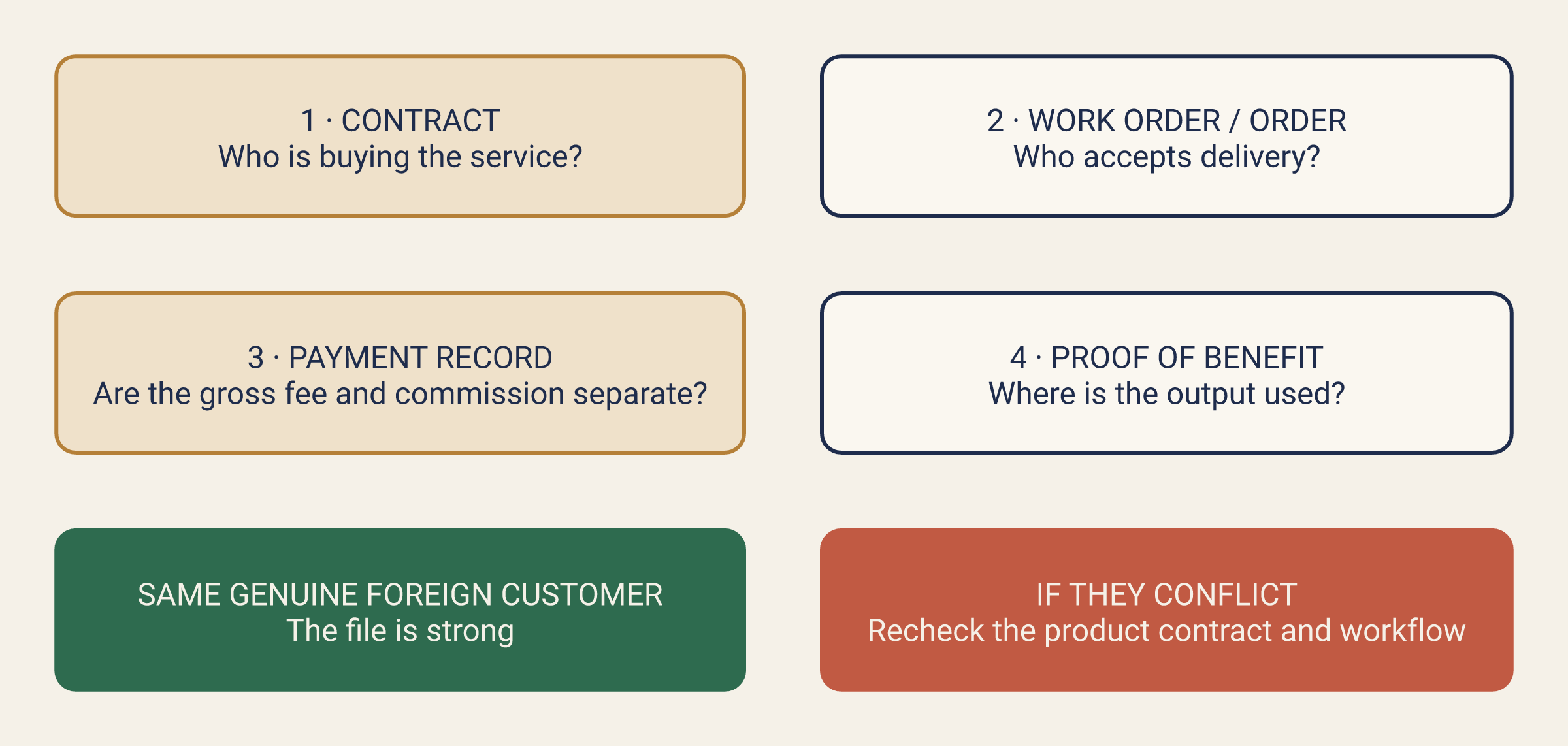
If these documents point to the same party, the file is strong. If they conflict, examine the product-specific version of the platform contract and the concrete workflow before issuing any document. No tax conclusion follows from the words “end client”, “buyer” or “platform” alone.
Escrow, collection and the transfer to Turkey: four separate dates
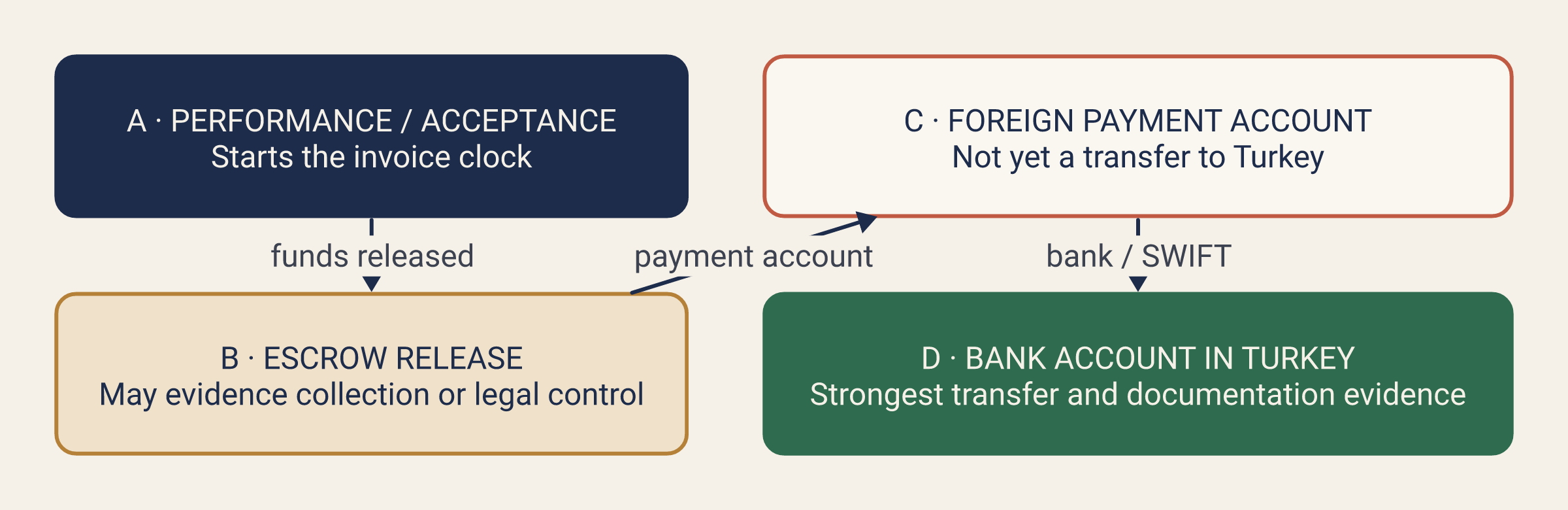
From the moment the freelance work is completed to the moment the money lands in a Turkish bank account there are four different dates. Each produces a different legal consequence.
| Date | What happens | Tax consequence |
|---|---|---|
| (a) Performance / acceptance date | The service is completed, or the contractual milestone is accepted | For commercial and corporate income, the invoice is issued under TPC Art. 231/5 within at most seven days from the date the service was performed. In milestone work the acceptance mechanism is examined separately. |
| (b) Escrow release date | The funds pass to the freelancer’s account under the contractual release condition | For self-employment income it is strong evidence of collection or of the amount becoming legally at the earner’s disposal; where there is a block, a dispute or a security period it may not be the definitive date on its own. |
| (c) Credit to a foreign payment account | The fee appears in a Payoneer/Wise-type account | Without establishing in which country and with which licensed institution the account is held, no “transfer to Turkey” conclusion can be drawn. |
| (d) Credit to the bank account in Turkey | The fee arrives in the Turkish account with a bank/SWIFT record | The strongest and lowest-risk route of proof for the transfer to Turkey and its documentation. |
The Mersin Revenue Office ruling of 11/6/2025, No. E-18008620-120[2023-720-39]-119534, separates the freedom under exchange-control rules from the transfer condition in the tax deduction. That the Export Circular does not oblige the service fee to be brought into the country does not remove the condition that the earnings claiming the deduction be transferred to Turkey and documented.
Relying on section 10.5.2.6 of Corporate Tax General Communiqué No. 1, the same ruling reports two consequences: if only part of the earnings is transferred in time, the deduction is not applied even to the transferred part; and a transfer made after the deadline does not create a deduction right for the earlier period. Even a small untransferred balance of qualifying earnings can therefore put the whole of the earnings at risk. Platform commission, chargeback/dispute reserves and out-of-scope collections must be separated in the records.
Exchange-control law and tax law are two separate layers: paragraph one of the current Article 22 of the CBRT Export Circular leaves at the exporter’s free disposal export proceeds not exceeding USD 5,000 or its equivalent for the transactions listed in the article, including service exports.
That freedom does not remove the “transfer to Turkey” condition in the ITC/CTC deduction. Although the statute names no single means of proof, a bank account in Turkey, the receipt and the SWIFT narrative form the safest file in practice. If an alternative Turkish payment institution is to be used, the institution’s licence, the legal position of the account and the transfer trail must be documented separately.
Sole proprietorship versus limited company: compare on the same assumptions
The 100% deduction is not the only yardstick in choosing a company form. The tax computation must be built together with the nature of the activity, expenses, social security status, profit distribution and liability needs.
CTC Art. 32/C introduces, from the 2025 accounting period and its advance tax periods, a domestic minimum corporate tax computed on corporate earnings before deductions and exemptions. Its important exception is new companies: for companies commencing business for the first time, the article does not apply for three accounting periods from the period in which business begins; companies formed through merger, transfer, change of form or partial or full division do not count as new for this purpose.
Corporate Tax General Communiqué No. 26 (Official Gazette 4/7/2026) added foreign intermediation earnings, the qualified service centre and the Istanbul Financial Centre financial services export deduction to the list of exemptions and deductions subtractable from the minimum base. The service export deduction (CTC Art. 10/1-ğ) was not added to that list.
The result: absent the first-three-accounting-periods exception or another exclusion, an Ltd/JSC that applies the 100% deduction in full and zeroes its ordinary corporate tax base still computes the minimum corporate tax under CTC Art. 32/C.
The third paragraph of CTC Art. 32/C allows the tax not collected because the five-point reduced rate under Art. 32 para. 7 was actually applied to be deducted from the minimum tax. Do not assume that every CTC Art. 10/1-ğ transaction falls within Art. 32/7 of itself; whether the activity is within Art. 32/7 must be assessed separately.
In the example, because the whole of the service export earnings is deducted under CTC Art. 10/1-ğ, no ordinary corporate tax base remains; no tax goes uncollected by reason of Art. 32/7 either. The five-point advantage was therefore not used as an automatic discount taking the 10% minimum tax down to 5%. Where there are out-of-scope or partly qualifying earnings, the computation changes.
The deduction applies not to gross revenue but to the post-expense net earnings of the qualifying activity. Revenue, platform commission, other costs and out-of-scope activities must be tracked separately.
| Monthly revenue | Annual gross (@42) | Expense assumption | Net activity earnings | Income tax after ITC Art. 89/1-13 | Ordinary corporate tax after CTC Art. 10/1-ğ | CTC Art. 32/C minimum 10%* |
|---|---|---|---|---|---|---|
| $5,000 | TRY 2,520,000 | TRY 378,000 | TRY 2,142,000 | ~0 | 0 | TRY 214,200 |
| $10,000 | TRY 5,040,000 | TRY 756,000 | TRY 4,284,000 | ~0 | 0 | TRY 428,400 |
| $20,000 | TRY 10,080,000 | TRY 1,512,000 | TRY 8,568,000 | ~0 | 0 | TRY 856,800 |
Table notes: USD 1 = TRY 42 is a representative rate; the expenses are the hypothetical amounts in the table; all of the income comes from the qualifying activity and all of the net earnings were transferred to Turkey in time.
It is assumed that the company is not within the first-time-commencement exception and that there are no other set-offs, exemptions or prior-year effects. Dividend withholding, formation/accounting costs and the VAT refund cash flow are not included. In a real transaction, self-employment income uses the exchange rate on the day of collection or of the amount becoming legally at the earner’s disposal; commercial and corporate income takes into account performance/accrual, period-end valuation and collection-linked exchange differences together.
The 4/b premium cost was not written into only one of the two models in the table. For limited company shareholders, 4/b insured status arises as a rule; the status of a non-shareholder director is determined not from the title alone but from the concrete working and service relationship. Without also checking concurrent insured status, incentive conditions and the current accruals, the social security cost is not to be counted as a company-form advantage.
Under the stated assumptions this table computes additional tax for the limited company because of CTC Art. 32/C. But do not choose the company form on this line alone; weigh liability, ownership, contracts, investors, profit distribution and the total compliance cost at the same table.
Gökay GÜL’s note: Close three risks before the transaction. Issue the document to the real contractual buyer — not by rote to the platform or to the end client. Do not leave the transfer of the whole of the earnings to Turkey to the last week. Verify, transaction by transaction, the document that fits the taxpayer status and the type of income — the e-self-employment receipt (e-SMM) for self-employment income, the applicable invoice regime for commercial/corporate income. How you correct a wrong document depends on the document type, the cancellation window, the counterparty and whether the return has been filed.
Risks: platform contracts, the limits of rulings and mixed benefit
No published Council of State decision was found in this search that carries the name Upwork, Fiverr or Toptal and directly determines the document counterparty by platform. That finding is limited to the platform terms searched; it does not mean there is no case law on service exports at all. Decisions whose citation and full text could not be verified were left out of account.
Published Revenue Administration rulings show the Administration’s approach; but every ruling rests on the concrete facts of its own addressee. Following a ruling issued to another taxpayer by analogy does not automatically confer the same protection under TPC Art. 369. Where the platform contract or the place of benefit is unclear, a written ruling sought for the taxpayer’s own concrete case builds a stronger protection file.
In mixed use, the question is not only whether the application is accessible from Turkey. What is examined is which service is supplied to whom, in which business the output is used, and whether domestic and foreign income streams are separated. The ITC/CTC earnings deduction and the service export exemption under VAT Code Art. 11/1-a and 12/2 have separate conditions; each transaction and income item is assessed on its own evidence.
In Toptal-style resale or managed service models, the party paying and the party benefiting from the service can differ. In that case the contractual buyer, the work order, the place where the delivery is used and any end-customer relationship are examined together. The end customer’s country alone is not a sufficient test for every transaction.
Worked example: reporting $5,000 of Upwork income
-
Contract stage. Match the client name in the Contract Room with the accepted offer, the work order and the payment record. In the Upwork standard marketplace model, User Agreement v8.2 as reviewed on 29 August 2026 forms the service contract between Client and Freelancer. Confirm the version in force at the transaction date; for Any Hire, enterprise or other products read the additional contract separately. Document the customer’s foreign character with the trade name, address, residence/business-establishment or registered-office and place-of-management details; do not present a certificate of residence as a legal requirement in every case.
-
Document timing. For self-employment income, issue the e-SMM by reference to collection or to the amount becoming legally at the earner’s disposal; check the escrow block and the security period. For commercial or corporate income, issue the invoice under TPC Art. 231/5 within at most seven days from the date the service was performed; in milestone work document the contractual acceptance date. An escrow payment does not of itself postpone the invoice. For the VAT exemption, the service being performed for the customer abroad, the benefit abroad and the invoice or equivalent document being issued in the customer’s name are tested together. If the conditions are met, use code 302 — Service Exports in VAT Return No. 1; complete the foreign-customer identity field by the current Revenue Administration/integrator guide.
-
Collection and transfer. Keep the movement between the payment account and the bank account in Turkey traceable. Match the receipt or SWIFT message with the contract and document number. The whole of the qualifying earnings must have been transferred to Turkey — for an individual by the annual income tax return deadline, for a company by the corporate tax return deadline of the relevant accounting period. On the general calendar these are the following year’s March and, for a company using the calendar year, the end of the following year’s April.
-
Annual return. Apply the deduction not to gross revenue but to the post-expense net earnings of the qualifying activity. For the 2026 period, apply the 100% rate on the ITC Art. 89/1-13 or CTC Art. 10/1-ğ line. For a corporate tax payer, then run the CTC Art. 32/C check, taking into account the first-three-accounting-periods exception and other exclusions.
-
The VAT refund file. Holding the payment document at filing is not compulsory for declaring the exemption. If a refund of input VAT will be sought, file separately the service contract, the invoice and the input lists, the computation and the bank record showing the service fee came to Turkey; under the current Communiqué the refund is not finalised before the fee has come to Turkey. Do not confuse the full-and-timely transfer condition of the ITC/CTC deduction with the two statutory conditions of the VAT exemption.
Action plan for taxpayers
- Look at your contract: who is the customer, who receives the payment, to whom will the document be issued — write all three down.
- Check the balance in the foreign payment account; leave no amount that cannot be transferred to Turkey and documented in time.
- Verify the document type: the e-SMM for self-employment income; for commercial or corporate income, e-Invoice, e-Archive Invoice or the other applicable invoice regime according to the taxpayer’s current e-document scope.
- Compare the sole proprietorship and the limited company on the same social security, expense and profit-distribution assumptions.
- In mixed-use software or digital services, track domestic and foreign customer/income flows separately; prove the place of benefit for each transaction.
Official sources
- Income Tax Code Art. 89/1-13 (as amended by Law No. 7491 Art. 10)
- Corporate Tax Code Art. 10/1-ğ and Art. 32/C
- Revenue Administration, 2026 Domestic Minimum Corporate Tax Guide and Corporate Tax General Communiqué No. 1 sections 32.5.4-32.5.6 — the Art. 32/7 reduced rate and the Art. 32/C credit
- Presidential Decision No. 11257 (Official Gazette 30/4/2026, No. 33239) — service export earnings deduction rate 100%
- Corporate Tax General Communiqué No. 1 (implementation principles 10.5.2.1–10.5.2.6)
- Corporate Tax General Communiqué No. 26 (Official Gazette 4/7/2026, No. 33300) — the minimum base list
- VAT Code Art. 11/1-a and Art. 12/2 — the service export exemption
- VAT General Implementation Communiqué II/A-2 — service exports; Revenue Administration table of documents required in VAT refunds — 302 Service Exports
- Tax Procedure Code — documentation obligations and the e-document communiqués
- Tax Procedure Code Art. 231/5 — the invoice to be issued within at most seven days from the date the service was performed
- CBRT Export Circular Art. 22 — free disposal of service export proceeds
- Mersin Revenue Office, E-18008620-120[2023-720-39]-119534, 11.06.2025 — the foreign-exchange document and the transfer-to-Turkey condition
- Aydın Revenue Office ruling, E-79690095-120[3-2023-120-319]-98264, 19.08.2024 — ETSY graphic design service exports
- Upwork User Agreement v8.2, version reviewed on 29 August 2026 — the standard marketplace Service Contract parties and the Payment Escrow role; the version in force at the transaction date must be confirmed separately
- Fiverr Terms of Service and Payment Terms, last updated January 2026 — checking the order and payment contract
- Social Security Institution, Premium Accrual and Collection for the Self-Employed, 2026 — 4/1-b premiums and the five-point reduction amounts
Frequently asked.
When did Turkey's 100% service export earnings deduction begin?
Presidential Decision No. 11257 set the rate at 100% for tax or accounting periods beginning on or after 1 January 2026. A calendar-year income tax payer applies 80% to the 2025 return and 100% to the 2026 return.
Do I invoice Upwork, Fiverr or Toptal, or the end customer?
Issue the document in the name of the real foreign customer identified by the concrete contract, work order, delivery and payment flow. The platform's name or its payment role alone does not determine the counterparty; each product and contract must be reviewed separately.
Is transferring only part of the earnings to Turkey enough for the 100% deduction?
No. The statute requires all qualifying earnings to be transferred to Turkey by the relevant annual return filing deadline. Under the approach in the Mersin Revenue Office ruling, a partial or late transfer does not preserve the deduction for the earlier period.
Does an escrow release count as a transfer to Turkey?
Not by itself. An escrow release can evidence collection or the amount becoming available, but a credit to a Turkish bank account, the bank receipt and the SWIFT trail form the strongest evidence of transfer to Turkey.
Does every online freelance service qualify for the 100% deduction?
No. The service must be software, design, engineering, data processing or another listed activity; it must be supplied in Turkey for a foreign customer, benefited from exclusively abroad, and satisfy the document and transfer conditions together.
Do freelance earnings require an e-SMM or an invoice?
The document type follows the nature of the income and the taxpayer form, not the platform. Self-employment income uses an e-SMM on collection or legal availability; commercial or corporate income follows the Tax Procedure Code invoice timing and the taxpayer's current e-document scope.
Does a limited company pay no corporate tax because the deduction is 100%?
Not necessarily. The ordinary corporate tax base may be reduced to zero, but the domestic minimum corporate tax under CTC Art. 32/C can still apply. The first three accounting periods of a genuinely new company and other exclusions must be checked separately.
Validate the tax decision
Let’s test this calculation against your company’s actual numbers.
Share the activity, income breakdown and current treatment. We will separate the applicable rate, evidence chain and filing impact for your facts.
Review the accounting and tax scope →Do not send passwords, OTP codes, tax returns, ledger attachments or confidential documents in your first message.