
Blog
I Bought a Car Through My Company, So I'll Deduct It From Tax: Why Half of That Sentence Is Wrong in 2026
In 2026, four ceilings and a single rate stop most of the 'put the car in the company and the tax drops' expectation from actually reducing the tax base: monthly rent 46.000 TL, purchase SCT+VAT 1.200.000 TL, depreciation capped at 1.380.000 / 2.600.000 TL; 70% of running costs are deductible, 30% is added back as a non-deductible expense. The real lever, though, is a question nobody asks: is the vehicle a passenger car (87.03) or a commercial one (87.04)?

In this article
Regulatory Note: This article is prepared as of 19 July 2026, based on Income Tax Law No. 193 (Art. 40/1, 40/5, 40/7 and Art. 68), Law No. 7194, Value Added Tax Law No. 3065 (Art. 30/b, 30/d), Income Tax General Communiqués Series No. 311 and No. 332 (No. 332: Official Gazette 31.12.2025/33124, 5th Repeating), Special Consumption Tax Law No. 4760 list (II), Corporate Tax Law No. 5520 (Art. 6 and Art. 32) and Motor Vehicles Tax Law No. 197 (Art. 14). The ceiling amounts are updated each year by the revaluation rate and are revised periodically. Always assess your specific case with your advisor.
“Let’s buy the car through the company — we’ll deduct the VAT and write off the cost, so the tax drops.” Every time I hear a business owner say this in 2026, I say the same thing back: the first half of that sentence is wrong for most passenger cars, and the second half is only half true. Because on a passenger car three separate restriction layers stack on top of one another — four ceilings and a single rate — and a far-from-trivial part of the “it all becomes an expense” expectation never reaches the tax base; it is added back as a non-deductible expense (KKEG).
The real question is hidden in one nobody asks: is the car you bought truly a “passenger car” in the eyes of the tax law?
60-Second Summary: For a passenger car the 2026 picture comes down to these four ceilings and one rate: (a) at most 70% of running costs (fuel, maintenance, insurance) are deductible, the remaining 30% is added back as KKEG; (b) at most 46.000 TL of monthly rent (VAT excluded) is booked as expense; (c) at most 1.200.000 TL of the SCT+VAT at purchase becomes a direct expense; (d) depreciation is taken with a ceiling of 1.380.000 TL on the SCT+VAT-excluded price, or 2.600.000 TL where the taxes are in the cost or the car is second-hand. On top of that, VAT on a passenger-car purchase is, as a rule, not deductible (VAT Law Art. 30/b). But every one of these restrictions is specific to a single class — the passenger car (customs code 87.03); on a commercial vehicle (87.04) none of these passenger-specific limits apply (the general conditions — business relevance, documentation and ordinary VAT rules — still hold). The right question is not “which car is more of a luxury” but “in the eyes of the tax law, is this car passenger or commercial?”
What Is the Passenger-Car Expense Restriction? Two Mechanics, One Rule
The passenger-car expense restriction is a regime that entered into force at the start of 2020 through Law No. 7194, amending the relevant subparagraphs of Article 40 (business income) and Article 68 (self-employment income) of the Income Tax Law. Its purpose is simple: to stop the money a business ties up in a passenger car from eroding the tax base without limit. The spending it covers is broad — fuel, maintenance and repair, insurance, rent, taxes at purchase, and depreciation.
The heart of the restriction is built on two different mechanics, and mixing them up is the most common mistake.
First mechanic — the ceiling. A cap in Turkish lira is set for rent, for the SCT+VAT at purchase, and for depreciation. The part exceeding the ceiling cannot be counted as expense or depreciation. These ceilings rise each year by the revaluation rate; the 2026 amounts were fixed by applying the 2025 revaluation rate of 25,49% (Tax Procedure Law General Communiqué Serial No. 585, Official Gazette 27.11.2025/33090) and were announced in Income Tax General Communiqué Series No. 332.
Second mechanic — the rate. Independently of the ceilings above, at most 70% of a passenger car’s running costs (fuel, maintenance, repair, insurance and the like) are deductible; the remaining 30% is added back to the base as a non-deductible expense (KKEG). This rate is fixed in the statute (Income Tax Law Art. 40/5) — it does not change with a communiqué or the revaluation. It was 70% in 2020, and it is 70% in 2026.
Seeing that these two mechanics run separately is critical: monthly rent first hits the 46.000 TL ceiling; running costs are then separately subject to the 70% rate. The portion of rent up to the ceiling is not subject to a second 30% cut — because rent is tied to its own ceiling under Art. 40/1, not to the “running cost” definition of Art. 40/5.
So what is the “passenger car” all of this applies to? This is where the key sits: the definition rests not on the brand, the price or the body type but on the customs (GTİP) code. Vehicles in position 87.03, designed essentially to carry people, are passenger cars and fall within the restriction. Vehicles in position 87.04, designed to carry goods (vans, panel vans, some double-cab pickups), are not treated as passenger cars and are subject to none of these restrictions. One caveat: 87.03 is a broad heading; special-purpose vehicles not principally designed to carry people (such as ambulances, hearses, prisoner/cash-transport vehicles, motorhomes) may appear in this position, yet whether they fall under the “passenger car” expense regime is assessed separately, based on their place in the SCT (II) list and the vehicle’s actual nature — do not automatically treat every vehicle labelled 87.03 as a “passenger car.”
Let me also flag the activity exemption up front, because it cuts through the income/corporate expense restrictions and the VAT deduction ban below. For taxpayers whose activity is wholly or partly the renting or operating of passenger cars in various ways (rental firms, licensed taxis, driving schools), the cars they use for that purpose are exempt not only from the VAT deduction ban but from all of the rent, expense and depreciation restrictions in Income Tax Law Art. 40 (the shared exemption in Art. 40/1-5-7 and VAT Law Art. 30/b).
The exemption depends not on the car’s class but on the taxpayer’s activity and on the car genuinely being used in that activity; a car the same firm allocates to its manager does not qualify.
The 2026 Ceilings and the Gap Between “Expected” and “Effective” Benefit
Let me put the table on the screen first. The four ceilings and single rate below contain the core numeric limits of the passenger car in 2026; the activity exemption, the VAT ban, pro-rata depreciation and finance leasing are added later in the article.
Table A — 2026 passenger-car restriction amounts
| Item | 2026 ceiling | 2025 (comparison) | Basis |
|---|---|---|---|
| Monthly rent expense (VAT excluded) | 46.000 TL | 37.000 TL | Income Tax Law Art. 40/1 · Comm. 332 Art. 3 |
| SCT+VAT bookable directly as expense at purchase | 1.200.000 TL | 990.000 TL | Income Tax Law Art. 40/1 · Comm. 332 Art. 3 |
| Depreciation — SCT+VAT-excluded first-acquisition cost | 1.380.000 TL | 1.100.000 TL | Income Tax Law Art. 40/7 · Comm. 332 Art. 3 |
| Depreciation — taxes in cost / second-hand | 2.600.000 TL | 2.100.000 TL | Income Tax Law Art. 40/7 · Comm. 332 Art. 3 |
| Deduction rate on running costs | 70% (remaining 30% KKEG) | 70% | Income Tax Law Art. 40/5 (statute, fixed) |
Most competing content stops right here: it lists the ceilings and moves on. But what actually needs explaining is this — when these ceilings stack, the part of the money tied up in a passenger car that is assumed to reach the tax base and the part that actually reaches it diverge sharply. I call this the effective benefit, and I always draw this table for taxpayers.
Let’s put a passenger car worth 3.000.000 TL into the business three ways and compare the “expected” versus “effective” impact on the base for each.
Table B — expected vs. effective base impact for a 3.000.000 TL passenger car (2026, illustrative)
| Scenario | How it is modelled | Expected base impact | Effective (after restriction) | Not deductible from the base (KKEG / disallowed) |
|---|---|---|---|---|
| A — New car, purchase (taxes in cost) | 5-year depreciation, ceiling 2.600.000 TL | 3.000.000 TL | 2.600.000 TL | 400.000 TL |
| B — 60-month operating lease (rent ~65.000 TL/month, VAT excl.) | Monthly rent ceiling 46.000 TL | 3.900.000 TL | 2.760.000 TL | 1.140.000 TL |
| C — Second-hand purchase | Depreciation ceiling 2.600.000 TL | 3.000.000 TL | 2.600.000 TL | 400.000 TL |
Simulation notes: The ceiling amounts rest on Communiqué No. 332; the derived figures are calculations. In Scenario A the whole price is capitalised and depreciated over a 5-year useful life (one-fifth a year); because the ceiling is 2.600.000 TL, annual depreciation stays at 520.000 TL, and the excess 400.000 TL can never be expensed.
A simplification caveat: for a passenger car, pro-rata depreciation applies in the year of acquisition — that is, in the first year depreciation is taken only from the month of acquisition to year-end, and the unbooked part is added to the final year. The “520.000 TL a year” in the table is used to show the total effect on a full-year assumption, not the period-by-period spread.
In Scenario B a monthly rent of 65.000 TL is assumed (illustrative); since the ceiling is 46.000 TL, the excess of 19.000 TL/month (1.140.000 TL over 60 months) is disallowed. This is a static simulation in which the 2026 ceiling stays constant across 60 months; because the ceilings are updated each year by revaluation, the 2027–2030 amounts cannot be known today, and the true five-year result depends on this assumption. In this table, running costs such as fuel/maintenance/insurance are separately subject to the 70% rule, and in every scenario 30% of those costs is added back as KKEG — not included in the amounts shown.
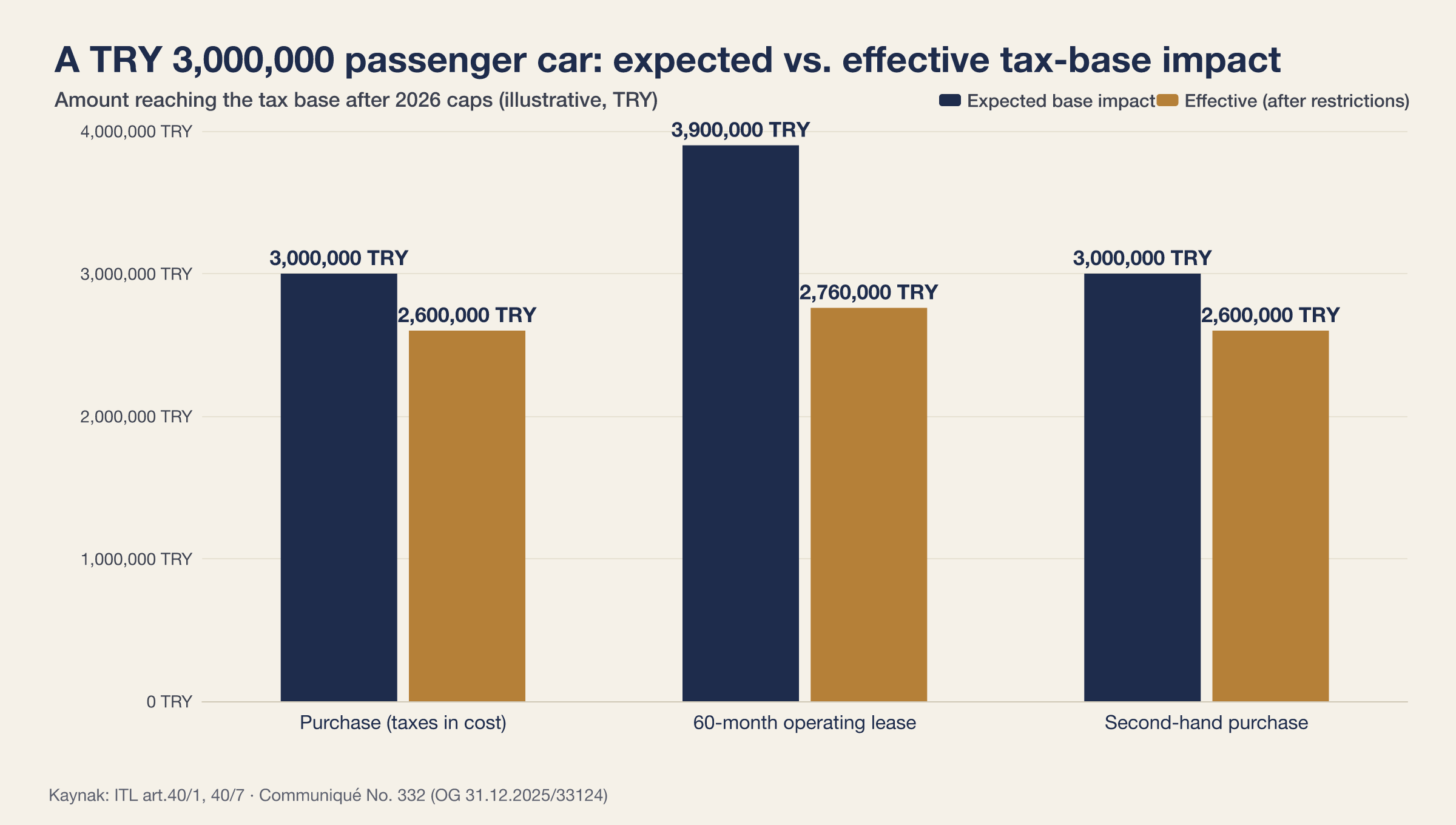
The table’s message is clear: the “I bought a 3-million car, I’ll expense 3 million” expectation drops to 2.6 million in the best case; on the leasing route, if the rent paid exceeds the car’s price, the gap widens further.
If we take corporate tax at 25% (the general rate is Corporate Tax Law Art. 32; sectoral exceptions aside), the expected 750.000 TL of tax saving on a purchase falls to an effective 650.000 TL — and that is before adding the 30% KKEG effect on running costs. This is not a saving that hits the pocket the same day; the depreciation effect is spread over years and is a nominal total effect resting on the assumption that there is enough taxable base each year and that the rate does not change.
Let me draw one more distinction clearly: what you do with the SCT+VAT at purchase is a choice. You can either book it directly as expense (Art. 40/1, ceiling 1.200.000 TL) or add it to cost and amortise it through depreciation (Art. 40/7, ceiling 2.600.000 TL). This choice is essentially made within the cost-value and valuation provisions of the Tax Procedure Law; Income Tax Law Art. 40 then sets the ceiling for each route. Which one favours you depends on the car’s tax composition and on your profit plan.
Decision Matrix: The Three Questions to Ask, in Order
When I put a passenger-car decision on the table, I ask three questions in this order. The order matters, because the first question often makes the other two moot.
Decision 1 — Is the vehicle passenger or commercial? (The biggest lever.) The entire restriction applies only to passenger cars, i.e. vehicles in customs position 87.03. On vehicles of the 87.04 class designed to carry goods (vans, panel vans and double-cab pickups that pass the test), there is no ceiling, no 70% rule and no VAT deduction ban.
For double-cab pickups the line is drawn by this technical test: if the floor length of the cargo area is more than 50% of the wheelbase, the vehicle counts as 87.04 (commercial); if less, as 87.03 (passenger) (Customs General Communiqué Series No. 2, Official Gazette 06.02.2010/27485; Istanbul Tax Office ruling dated 10.07.2013, No. 39044742-SCT). More than two axles also points to 87.04. In borderline cases very close to or exactly at the ratio, this measurement alone should not be treated as decisive; in such marginal situations and for high-value purchases generally, apply for binding tariff information (BTI). Since the underlying communiqué and the SCT (II) list can be updated from time to time, verify the current text before deciding. This single decision usually creates a bigger tax difference than the two decisions below.
Decision 2 — Buy, lease, or second-hand? If the vehicle really is passenger, the financing route determines which ceiling you hit. On a purchase the depreciation ceiling (2.600.000 TL or 1.380.000 TL) comes into play. On an operating lease the monthly 46.000 TL ceiling applies, and a rent kept below that ceiling can be more flexible than the depreciation ceiling.
One technical detail: finance-lease payments are not subject to the monthly rent restriction (Communiqué 311 Art. 13/5); the payment is accounted for by splitting it into principal and interest under Tax Procedure Law Art. 290 (repeating), and on a car tracked under the “Rights” account the depreciation ceiling applies (Communiqué 311 Art. 15/7).
Decision 3 — What do we do with the VAT? The most commonly mistaken expectation here is: “we’ll deduct the VAT.” As a rule you cannot. The VAT shown on the purchase documents of a company-owned passenger car is not deductible under VAT Law Art. 30/b; it becomes an expense or cost element.
The exception to this ban is narrow — mainly those whose activity is renting or otherwise operating passenger cars (rental firms, licensed taxis, driving schools); the ban also does not apply to cars acquired as stock to resell by those whose business is trading passenger cars. For an ordinary SME buying a car for its own use, the exception does not apply.
VAT Law Art. 30/d adds this: VAT on expenses that are not accepted as deductible (KKEG) in income/corporate tax is also non-deductible — so the VAT attributable to the rent excess or to the 30% of running costs is likewise lost.
One threshold warning: the 70%/30% mechanic does not exist in the motor vehicles tax (MVT), and the source of that distinction is not the Income Tax Law but Motor Vehicles Tax Law No. 197 Art. 14. That article says the MVT levied on vehicles in tariff (I) (car, off-roader, all-terrain — i.e. passenger) is not accepted as an expense in determining the income and corporate tax base; so a passenger car’s MVT is, as a rule, not deductible (all of it KKEG).
By contrast the cargo/commercial vehicles in tariff (II) (minibus, bus, van, truck, tractor unit, etc.) are not on the Art. 14 list; their MVT can be expensed. The article has its own exception: for firms in the vehicle-rental business, MVT on the vehicles they lease out for that purpose is deductible even if the vehicle is a passenger car.
Also, for the self-employed (Income Tax Law Art. 68) the ceiling amounts are the same as in business income; the practical difference is in the mechanic — because self-employment income is already found by deducting allowable expenses from revenue, the part exceeding the ceiling is not added back as a separate KKEG item as in business income, but simply left out as a non-deductible expense.
Gökay GÜL’s Note: I always tell owners this: do not make the “so it drops the tax” car decision without first nailing down the vehicle’s registration type and its customs (GTİP) code. For the same budget, a commercial vehicle classified as GTİP 87.04 (usually in category N1) delivers, in most cases, a markedly larger real expense advantage than a passenger SUV — because it carries none of the passenger-specific 70% rule, depreciation ceiling or VAT deduction ban. But do not read that in reverse: “let me buy an 87.04 so the tax drops” is the wrong order. The right question is — does the business genuinely need to carry goods/cargo? If so, an 87.04 both does the job and lifts the restriction; if not, a vehicle bought merely to change class puts you at a different risk. A warning: the N1 type-approval class alone does not guarantee an 87.04 outcome; the decisive factor is the GTİP. And do not miss this: being 87.04 lifts the passenger-car restrictions but does not make the spending unrecorded — the purchase price is not a direct expense; under the Tax Procedure Law it is amortised through depreciation, and business relevance, documentation and the general VAT conditions are required in every case.
The real risk regardless of class — private use: Whether the vehicle is 87.03 or 87.04, if it is allocated to a partner or a manager and effectively opened to private use, the classification will not save you. In that case what comes onto the agenda is treating the benefit provided to personnel as wages, on the partner side a disguised profit distribution (transfer pricing), and the disallowance of spending whose business relevance cannot be established, together with the associated VAT consequences. So “I bought an 87.04, everything is deductible now” is not a safe harbour; what is decisive is the vehicle’s actual use and documenting it (assignment record, mileage/route). Before buying, request in writing from the seller the vehicle class and the GTİP on the conformity certificate; for high-value purchases where there is doubt, go for a binding tariff/ruling assessment on the customs classification — do not rely on the showroom’s “this counts as commercial.”
A Case From the Field: The 2,8-Million SUV Everyone Thought Was “All Expense”
Note — illustrative example: The case below is a composite distilled from situations frequently seen in advisory practice; it does not describe a single real taxpayer one-to-one. The figures are typical magnitudes used to show the mechanics.
A mid-sized manufacturing SME based in Central Anatolia bought a passenger SUV worth 2.800.000 TL (total acquisition cost including SCT and non-deductible VAT) in the company’s name at the start of 2026. The owner’s expectation was spelled out plainly: “The whole car gets expensed anyway, we’ll deduct its VAT, and a serious amount of tax comes off the profit.” Accounting was planning to capitalise the car, spread it over five years, and post the purchase VAT to the deduction accounts.
When we built the table together, the expectation broke in three places. First, the car was a passenger car in position 87.03; because the taxes were in the cost, the depreciable base hit the 2.600.000 TL ceiling — in this illustrative example the part of the car exceeding the ceiling (2.800.000 − 2.600.000 = 200.000 TL) could never enter depreciation.
Second, the purchase VAT was not deductible (Art. 30/b); the amount posted as deductible had to be corrected and moved to cost/expense. Third, only 70% (252.000 TL) of the roughly 360.000 TL annual fuel-maintenance-insurance cost would come off, while 30% (108.000 TL) would be added back to the base as KKEG.
The result: the owner’s “all 2,8 million becomes a first-year expense” expectation was already contrary to the depreciation regime; accounting’s plan was also internally inconsistent. Because the same VAT cannot at once be kept in the cost (inside the 2.800.000 TL depreciable base) and recovered through deduction — only one of the two happens.
The correct construction is one-directional: because VAT is non-deductible under Art. 30/b, it stays in the cost. The depreciable base then hits the 2.600.000 TL ceiling. In the first year only 520.000 TL of depreciation (2.600.000 ÷ 5) and 252.000 TL of running-cost expense (70% of 360.000) — 772.000 TL in total — can come off the base.
Compared with the owner’s imagined table of “first-year the entire car cost (2.800.000) + running costs (360.000) = 3.160.000 TL of expense, plus a separate VAT refund,” the real first-year base impact (772.000 TL) was roughly a quarter of that; and the expected VAT deduction never arose at all (these figures exclude pro-rata depreciation and assume a full year, illustratively).
In the same meeting we asked a simple question: is this vehicle’s function mainly field/service work, or manager comfort? If the function is mainly field transport — that is, if the vehicle genuinely serves a goods/cargo-carrying need — a double-cab commercial vehicle classified as GTİP 87.04 (most in category N1) bought for the same budget would switch off the passenger-car restrictions.
Concretely: the passenger-specific 70% limit and depreciation ceiling would not apply, the purchase price would be amortised under the general depreciation provisions, running costs would come off to the extent they relate to the business, and VAT would be deductible under the general conditions. But that outcome depended on the vehicle’s real use; had it been bought for manager comfort and opened to private use, the benefit/wage and business-irrelevance assessment would still come onto the agenda even with an 87.04 class.
The decision changed for the next purchase; the existing SUV was tied to the return with the restrictions correctly built in (because the wrong VAT deduction was corrected before the return was filed, no penalty or late-payment interest arose). The lesson in one sentence: on this subject money is usually lost not on the wrong ceiling but on the wrong vehicle class.
Frequently Asked Questions
1. What is the 2026 monthly rent expense ceiling for a passenger car? At most 46.000 TL a month (VAT excluded) can be taken as an expense (Income Tax Law Art. 40/1, Communiqué No. 332). In 2025 this amount was 37.000 TL. Rent exceeding the ceiling, and the VAT attributable to the excess, cannot be expensed.
2. How much of the SCT+VAT on a car purchase can be expensed? At most 1.200.000 TL can be taken directly as expense (Income Tax Law Art. 40/1). Alternatively you can add these taxes to cost and amortise them through depreciation; then the 2.600.000 TL depreciation ceiling applies. Which one favours you depends on the car.
3. What is the depreciation ceiling in 2026? There are two amounts: 1.380.000 TL for the SCT+VAT-excluded first-acquisition cost; 2.600.000 TL where the taxes are added to cost or the car is bought second-hand. The ceiling in force on the acquisition date is the one that applies.
4. Is there an expense restriction on a commercial vehicle? The passenger-specific restrictions (the ceilings, the 70% rule, the VAT deduction ban) apply only to GTİP 87.03 vehicles; on 87.04-class vehicles designed to carry goods (van, panel van, double-cab pickup that passes the test), none of them apply. But this does not mean the whole expense is deductible without condition: business relevance, documentation, the matching principle and the general VAT deduction conditions (VAT Law Art. 29 ff.) are required in every case. In short, on an 87.04 “there are no passenger-specific limits; the general expense and VAT conditions still hold.”
5. What happens to 30% of the costs? Only 70% of a passenger car’s running costs (fuel, maintenance, insurance, etc.) is deductible; the remaining 30% is a non-deductible expense (KKEG) and is added back to the base (Income Tax Law Art. 40/5). The VAT attributable to that 30% is also non-deductible (VAT Law Art. 30/d).
6. Can I deduct the VAT on a passenger-car purchase? As a rule, no (VAT Law Art. 30/b); the VAT becomes an expense or cost element. The main exception is those whose activity is renting/operating cars (rental firms, licensed taxis, driving schools) and cars acquired to resell by those trading in passenger cars. On a car an ordinary SME buys for its own use, the purchase VAT is not deductible.
Before You Buy: A 6-Step Restriction Check
- Verify the class with documents (before buying): Request in writing from the seller the vehicle’s class on the conformity/type-approval certificate and its GTİP position (87.03 or 87.04). For double-cab pickups, have the 50% cargo/floor test confirmed.
- Draw the scenario table: Build the “expected vs. effective base impact” table (the Table B logic) for purchase, operating lease and second-hand, using your car’s price.
- Decide the SCT+VAT choice: Direct expense (1.200.000 TL ceiling) or add to cost and depreciate (2.600.000 TL ceiling) — choose with your accountant according to the car’s tax composition.
- Set the VAT up correctly from the start: On a passenger car, plan the purchase VAT as expense/cost rather than a deduction; treat the VAT attributable to the rent excess and to the 30% KKEG as non-deductible.
- Establish running-cost discipline: Build the 70%/30% split into the accounting from the start for fuel/maintenance/insurance; track the passenger car’s MVT (MVT tariff (I)) so that all of it is KKEG — while cargo/commercial vehicles’ MVT (tariff (II)) can be expensed.
- Write the lease contract to the ceiling: On an operating lease, assess the monthly rent and VAT in light of the 46.000 TL ceiling; on a finance lease, reflect the principal/interest split in the contract.
How I handle the company-car decision
When a client says “I’m going to buy a vehicle,” I build the case from the front, not the back. First I get the seller to confirm in writing the vehicle’s registration type and its customs (GTİP) code — 87.03 or 87.04 — because that alone decides whether the restriction bites. Then, for the same budget, I put the purchase, operating-lease and second-hand scenarios side by side as “expected vs. effective tax-base impact.” We choose whether to write the SCT+VAT as a direct expense or add it to cost and depreciate, based on the vehicle’s tax composition; and we build the 70%/30% split, the VAT deduction ban and the non-deductible side of MVT into the bookkeeping from day one. The goal is to replace the “it’ll cut my tax” expectation with the vehicle’s real numbers.
If you are thinking of buying a company car, send me the model and registration class, the rough price and whether you genuinely need to carry goods/cargo; before you sign, we’ll map together whether the restriction hits you and what the real tax-base impact is.
Sources
- Income Tax Law No. 193 Art. 40/1, 40/5, 40/7 and Art. 68/4-5
- Corporate Tax Law No. 5520 Art. 6 (determination of net corporate income/base) and Art. 32 (general corporate tax rate 25%)
- Motor Vehicles Tax Law No. 197 Art. 14 and tariffs (I)/(II) — the rule that MVT is not deductible
- Law No. 7194 (Official Gazette 07.12.2019/30971) — the regime introducing the passenger-car expense restriction
- Income Tax General Communiqué Series No. 332 (Official Gazette 31.12.2025/33124, 5th Repeating) — the 2026 ceiling amounts
- Income Tax General Communiqué Series No. 311 (Official Gazette 27.05.2020/31137) — Fifth Section, application procedure
- Tax Procedure Law General Communiqué Serial No. 585 (Official Gazette 27.11.2025/33090) — 2025 revaluation rate 25,49%
- VAT Law No. 3065 Art. 30/b, Art. 30/d; VAT General Application Communiqué (III/C-2)
- SCT Law No. 4760 list (II); the GTİP 87.03 / 87.04 distinction — Customs General Communiqué Series No. 2 (Official Gazette 06.02.2010/27485)
- Istanbul Tax Office ruling 10.07.2013 (39044742-SCT 01.ARTICLE GENERAL-1014); VAT Circular No. 60
- GİB guide “Deduction of Expenses and Depreciation for Passenger Cars from the Tax Base”; TÜRMOB and Big4 2026 circulars — secondary confirmation
Frequently asked.
What is the 2026 monthly rent expense ceiling for a passenger car?
At most 46.000 TL a month (VAT excluded) can be taken as an expense (Income Tax Law Art. 40/1, Communiqué No. 332). In 2025 this amount was 37.000 TL. Rent exceeding the ceiling, and the VAT attributable to the excess, cannot be expensed.
How much of the SCT+VAT on a car purchase can be expensed?
At most 1.200.000 TL can be taken directly as expense (Income Tax Law Art. 40/1). Alternatively you can add these taxes to cost and amortise them through depreciation; then the 2.600.000 TL depreciation ceiling applies. Which one favours you depends on the car.
What is the depreciation ceiling in 2026?
There are two amounts: 1.380.000 TL for the SCT+VAT-excluded first-acquisition cost; 2.600.000 TL where the taxes are added to cost or the car is bought second-hand. The ceiling in force on the acquisition date is the one that applies.
Is there an expense restriction on a commercial vehicle?
The passenger-specific restrictions (the ceilings, the 70% rule, the VAT deduction ban) apply only to GTİP 87.03 vehicles; on 87.04-class vehicles designed to carry goods (van, panel van, double-cab pickup that passes the test), none of them apply. But business relevance, documentation, the matching principle and the general VAT deduction conditions (VAT Law Art. 29 ff.) are required in every case.
What happens to 30% of the costs?
Only 70% of a passenger car's running costs (fuel, maintenance, insurance, etc.) is deductible; the remaining 30% is a non-deductible expense (KKEG) and is added back to the base (Income Tax Law Art. 40/5). The VAT attributable to that 30% is also non-deductible (VAT Law Art. 30/d).
Can I deduct the VAT on a passenger-car purchase?
As a rule, no (VAT Law Art. 30/b); the VAT becomes an expense or cost element. The main exception is those whose activity is renting/operating cars (rental firms, licensed taxis, driving schools) and cars acquired to resell by those trading in passenger cars. On a car an ordinary SME buys for its own use, the purchase VAT is not deductible.
Validate the tax decision
Let’s test this calculation against your company’s actual numbers.
Share the activity, income breakdown and current treatment. We will separate the applicable rate, evidence chain and filing impact for your facts.
Review the accounting and tax scope →Do not send passwords, OTP codes, tax returns, ledger attachments or confidential documents in your first message.